| Introduction | Historical Background | Chronology | Geography | Biography | Technology | Ownership and Financing | General Bibliography |
| Southwestern
States |
Colorado | Denver |
Denver was established in 1859.
The Capitol Hydraulic Company of Arrapahoe County was incorporated in 1860 by A. C. Hunt, Charles H. Gratiot, John A. Clark, Thomas Pollock, Henry Allen, William M. Slaughter, Richard Sopris, A. P. Vasquez, A. Sagendorf, W. N. Byers, H. H. Scovill, Jr., J. A. McDonell, F. Z. Solomon, and John H. Wing "to conduct the water from both said streams by canal or ditch across the plains or intervening lands to the cities of Auraria, Denver and Highland, in the county of Arapahoe, territory of Kansas, and have the exclusive privilege of using and controlling the same for mechanical, agricultural, mining and city purposes."
The Denver City Water Company was organized on October 30, 1870 and built a Holly water system that began supplying water on January 10, 1872. A competitor, the Citizens' Water Company, was organized on March 30, 1889 and built a gravity system fed from deep gravel beds of the South Platte River, twenty-two miles from the city. This new system began service on October 1889. Ruinous competition between the two system led to a consolidation as the Denver Union Water Company on October 18, 1894.
The Denver Union Water
Company was bought by the Denver Water Board on November 1, 1918 for $14
million.
The waterworks are currently owned by the Denver Board of Water Commissioners.
Also see District Heating in Denver
|
|
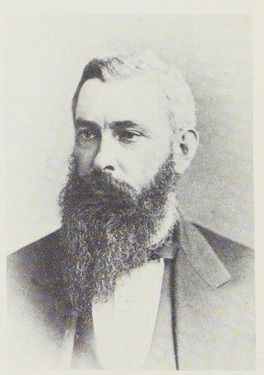
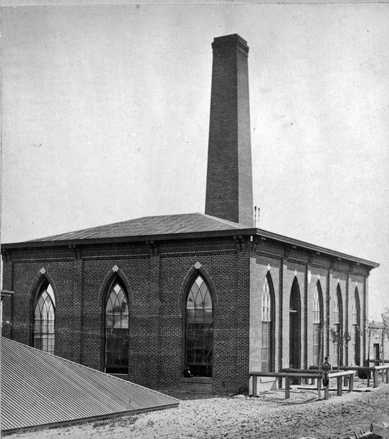
| James Archer | Denver Waterworks Buildings |
References
1859 Hand
Book to the Gold Fields of Nebraska and Kansas: Being a Complete Guide
to the Gold Regions of the North and South Platte, and Cherry Creek
... ; Containing Narratives of Trips to and from the Gold Region in
the Years 1858-59, by William Newton Byers and John H. Kellom
1860 An act to incorporate the Capitol Hydraulic Company of Arrapahoe County. February 21, 1860.
1863 The first telegraph line to Denver was completed on October 10, 1863.
1867 An act to change the name of the Capitol Hydraulic Company. January 10, 1867. Shareholders authorized to change name to Platte Water Company.
1867 Union Pacific completes railroad to Cheyenne, November 18, 1867
1868 The Union Pacific Railway, (Eastern Division) Or (Kansas Pacific Railway): Economy to the Government
1869 "The
Kansas Pacific Railway," The Rocky Mountain News, May 17,
1869, Page 1.
Our conviction that the expenses of the road will be considerably reduced
on reaching Denver, are founded greatly on the fact that of the entire
running expenses for 1868 nearly one fourth was for fuel. This was wood,
much of it inferior, purchased at high rates at different points along the
road, or transported at heavy cost from the timbered district near the
Missouri river. By using the coal found near Denver or Cedar Point, it is
estimated that, as it can be distributed along the line eastward at the
company’s convenience and with scarcely any expense except loading, a
saving of 75 per cent, may be gained in this item.
1869 James Archer incorporates the Denver Gas Company on November 13, 1869.
1870 "The
Gas Works: What the Denver Gas Company has done," The
Rocky Mountain News, October 25, 1870, Page 4.
The gas holder was made in Cincinnati, Ohio, and the pipe and cement were
purchased in Louisville, Ky. The iron frame for the roof was put on the
first gas works erected in St Louis twenty-four years ago, which were the
same capacity as these. It was then used in Quincy, and finally sold to be
transferred to Denver, when the works in the latter city became too small.
There has been received here twelve car loads of pipe, 120 tons of cast
and 16 tons of wrought. The foundations of the works were begun on
the 3rd, and the pipe laying on the 20th of September.
1870 The Denver City Water Company was organized on October 30, 1870
1870 The Rocky
Mountain News, December 4, 1870, Page 4.
The communication presented to the City Council at its last meeting by Mr.
James Archer, president of the Denver Water Company is published. It asks
an exclusive right to lay water pipes; agrees to lay three miles of pipe
within one year; also to erect hydrants for the use of the fire
department, for which the city is to pay $150 per year; also that water
rates to citizens shall not exceed those of St. Louis; and that at the end
of twenty years the city shall have the privilege of buying them by
valuation. The proposition seems extremely fair and favorable.
1870 James Archer and the City Council agreed to a water contract, December 16, 1870
1871 Denver was first lighted with gas on January 22, 1871.
1871 "The
Holly Water Works," The Rocky Mountain News, April 8, 1871,
Page 1.
Charles Keep, secretary of the Holly Manufacturing company, of Lockport,
N.Y.
1871 "'Our
Holly,'" The Rocky Mountain News, April 9, 1871, Page 1.
Late in the afternoon, a contract was signed by the Denver water works
company and Mr. Charles Keep, of the Holly manufacturing company, for the
construction of a set of the Holly machinery. It is stipulated to be
the same size as that in use at Indianapolis, Indiana, and will cost,
together with the pipe, about $150,000. Mr. Keep at once telegraphed the
Holly company to commence immediately the manufacture of the machinery-. A
telegram was also sent to the Associated Press that arrangements of the
above character have been entered into, and that the works will be ready
for operation about the first of November next.
1871 "Water
Works," The Rocky Mountain News, April 11, 1871, Page 1.
Details of the Holly Water Works
1871 "The Holly water
works of Denver," Denver Tribune, November 6, 1871, from History
of the Denver Water System 1858-1919, by Earl L. Mosely (1966)
2:198.
"The engine room is the principal one containing two sets of works
complete, either or both of which may be run at a time. They may briefly
be described as stationary fire engines, with as many miles of hose laid
and ready to turn their streams upon a fire, as there are miles of street
pipe. The larger is a piston engine of 350 horsepower; the smaller a
rotary of 200 horsepower. The larger engine runs two rotary pumps, whose
capacity is 20 gallons each at every revolution, or 2,000,000 gallons
each, every 24 hours. The smaller engine runs six piston-pumps, whose
capacity is 3,000,000 gallons a day, or including the rotary pumps about
7,000,000 a day. (Peak capacity). The larger engine and one of its pumps,
which supplies the pipes for street purposes, will be kept running all the
time; one or more of the smaller pumps is for domestic purposes.
"Some of the pumps will be kept in reserve, though the entire force can be
instantaneously turned on for fire or other purposes."
1871 "The
Phylosophy of Water Supply," The Rocky Mountain News,
December 8, 1871, Page 2.
Denver has many great enterprises, but the chief of them all—the cynosure
of every eye, especially that of an intelligent man—is the magnificent
system of water works which has been erected by Colonel James Archer, at
the junction of Cherry creek with the Platte river. Enterprises of so
extensive a character are not common, unless they are projected and
carried on by city councils, or similar corporation and, costing, as they
do, in the aggregate over $200,000. Several of our prominent citizens have
taken pecuniary interests with Colonel Archer, to show their desire to aid
the good work and to sympathize with him in his efforts to build up our
growing city. A brief history of the institution may here not be out of
place.
THE WELL
is located about two hundred feet from the south bank of the Platte river,
and was originally sunk thirteen feet deep, with a superficial area of
17x16 feet square, formed of round pine piles, twelve inches in diameter,
driven down, then faced with twelve-inch square sills. The capacity not
being sufficient for the contemplated supply, they are proceeding to
enlarge it to 50x30 feet, inside measurement, with a crib or caisson,
under the direction of our popular mechanic, Fred. Cramer. The crib is
four feet thick, faced and backed with six-inch planking, well bolted and
secured, loaded and filled in with the Erie building stone and coarse
gravel—this acting as a filter, or purifier, although we can hardly
imagine a more clear or pellucid water than is naturally found here,
percolating as it does through the fine silicious bed of Cherry creek. As
this crib is building, the water is being drawn out and excavators are
picking away beneath it, gradually sinking it down at the rate of twelve
or eighteen inches per day, to the bed-rock, or rather bed of granite
boulders which underlies the superincumbered sand or gravel, until a
permanent foundation is reached. The water in this well is Cherry creek
water, disclosing a rather singular fact, as the height of the surface oi
the water is six inches higher than the Platte river at this point, though
so close to the edge of it.
THE CENTRIFUGAL SUCTION PUMP
which exhausts the water from the well while the excavation is
progressing, separate and distinct from the rest of the machinery, except
by a forty-foot section of belting, is located over the well, and, with
the massive engines, is a patent of Mr. B. Holly, of Lockport, New York.
It has a discharge pipe of six inches in diameter, and a forcing capacity
of twenty thousand gallons per hour, nearly as much as the volume of the
West Denver ditch, and nearly a fourth as much as the ditch of the Platte
Water Canal company, as per General Case’s calculation. This pump is
placed there only for excavating purposes.
THE SIX POWERFUL GANG PUMPS
are connected with the well by a main suction pipe, twenty inches in
diameter. The gang suction pipe is fifteen inches in diameter. The six
water pumps are sixteen inches in diameter, with pistons and cylinders
finely engine-turned, perfectly vertical to a hairsbreadth and true to a
die, giving scarcely any friction; each pump having air stop cocks, and
each a distinct and different period of motion or stroke, giving a
different suction at each one sixth ; the whole combining to give a
complete revolution; thus completing the accelerating force, and providing
for the ebb or recoil of so great a body of water. An air pump is also
attached to them, which is run in connection with the low pressure engine.
This pump takes the air, water, and steam which accumulates in the
condenser and conducts it to a receiving well, from where it is again
carried at a heated temperature into the boilers to be economised in
raising steam. The great columns of iron forming the framework or support
of the fabric are hollow, and serve as discharge pipes and air chambers.
The connection of the pumps with the engines is effected by what are
technically called clutch couplings, formed of two powerful sets of arms
or fingers, fitted on the horizontal shaft, locking into each other, when
desirous of connecting them, like hand grasping hand. When the pumps are
required to be stopped, a turn of a small wheel, unclasps the clutches,
severing the connection and necessarily stopping the pumps by withdrawing
the motor power. This obviates the old plan of throwing off the belt by
band. Each of the fingers of the clutches are tipped with india-rubber
pads, which prevent the jar which would otherwise arise when the coupling
is effected, probably as we would judge, giving an elasticity of about
half an inch.
THE MASSIVE ENGINES
are an illustration of extreme elegance and immense power. They are run on
both the high and low pressure principle; of four hundred practical horse
power, though capable of much higher. They are run with a gauge at forty
or fifty pounds of steam usually ; though, on an emergency, they can
safely reach a much higher amount. They have three gauges on the engines:
the centre one recording the water in the main street pipes ; the right
hand one shows the vacuum and the left the height of steam pressure. The
great balance or fly wheel, ten feet in diameter, weighs six thousand five
hundred pounds, which seems to the uninitiated rather diminutive, when the
immense power of the engines are considered. There is also a steam
condenser which saves ten or twelve pounds of pressure, this gaining and
utilizing part of the atmospheric pressure. The cut-offs turned by little
hand wheels, by the almost imperceptible motion of the hand draws off the
clutch couplings, throws out the gearings and stops the pumps in a second.
There is a safety valve also, in case six or more hydrants up town, being
in active service distributing water, should be suddenly stopped. If
provision was not made for such an emergency, the recoil would cause such
a tremendous shock as to shatter everything to atoms ; but this valve, on
such an event, opens just at the right moment and lets the great recoil of
water easily and gently down into the reservoir or well. The steam
expansion is also saved by a cut-off with a cam or eccentric shaft, which
is a beautiful and at the same time simple mechanical movement. These two
piston engines are worked on one crank, obviating a dead centre, saving
friction and power. Every portion of the whole is furnished with
self-oiling cups on every bearing.
The rotary engine is a concentrated essence of beauty and strength, and
furnishes a fruitful theme for study and thought on the Æesthetics of
machine construction ; of two hundred horse power, it looks like a little
coffee roaster or a one horse reverberator, by the side of its herculean
compeers. Used only on occasion of a fire, it is indeed multum in
parvo.
The automatic regulator or danger telegraphist, takes the place of the old
time-honored governor, only on a more extended scale, looks like a
miniature gasometer or an upright iron bellows, which is governed by
weights and is really a water meter ; which, when a hydrant is used up
town, and three times opened, gives out three distinct shrill whistles,
raising the alarm, causing the engineer to instantly fire up, put on the
power of the engines, and force the water to the needed point. It can be
regulated according to the amount of water required or the necessity of
the case, by adding or taking from the layers of iron weights which cover
the valves. The donkey is a small engine by the side of the others, used
to pump the water in filling the boilers. This is only used on an
emergency. There are pumps connected with the pistons of the engines which
are always in operation, doing the regular work of boiler supply. The
floor or coping of the engine room is made of massive slabs of Colorado
stone, from the works of Mr. Morrison, on Bear creek, one of which alone
weighs six tons.
THE BOILERS.
The two vertical tubular boilers are each seven feet in diameter, eight
feel high, with five hundred flues or tubes, appearing like two locomotive
boilers set upright on an end with sugarloaf conical caps. The furnaces
are lined with fire brick, and the Erie coal is used as fuel. There is a
powerful blower or bellows attached, which assists in firing up, if the
ordinary draught of the furnace is insufficient for emergencies. The
arrangement of the boilers and the flues or tubes, coming down as they do
right in conjunction with the fire, makes it a matter of easy moment to
get up steam in about five minutes. They have the ordinary steam gauges;
besides which they have patent glass water gauges, recording with accuracy
in a glass tube outside the boiler and prominent before the gaze of the
engineer, the exact height of the water in the interior. There can be no
excuse whatever for the engineer if he is so careless as to let his water
get down below the safety point. The safety valves also are so large and
so effective in their manipulation that the entire quantity of steam can
be immediately let off, leaving no pressure whatever on the boiler plates,
except the mechanical weight of the water within. Under such perfect
arrangements, and so superb a collection of machinery, it is next to an
impossibility for an accident to happen, as so great a portion of the
whole is governed by automatic, mathematical and mechanical laws. The
smoke stack measures nine feet square at its base, six feet square at its
apex, and eighty feet high.
THE BUILDING
comprises two largo rooms—the engine and boiler rooms. The first is 36x48
feet and the latter 25x37 feet in the clear. The foundation has one
thousand perches of stone from the Golden City quarries. The roof is a
specimen of elegant workmanship and its strength can be shown by saying
that when a portion of the machinery, weighing fifteen tons, was suspended
from it, a link of the chain, by some means, got doubled and suddenly gave
way, the whole weight falling on the other links with a severe shock, the
workmen on the roof at the time did not so much as feel a jar. The gross
weight of the whole stupendous machinery is one hundred and twenty-five
tons. The rock foundations are eight feet thick.
This article has already reached a length which forbids a more extended
sketch at present, and when the whole thing is put to a test trial, which
will take place in a few days, a detail of the modus operandi of
discharge through the pipes on the various streets and the manipulation of
the hydrants will be fully explained. Mr. A. Holly, the brother of the
patentee, has been on the ground superintending the whole work, from its
inception. Mr. Fred. Cramer is the superintendent of construction, and the
work fully justifies us in saying that he is a master of his art. Mr.
George W. McClure and Mr. James Chapman, are the engineers in charge ; the
former is our well known citizen, and the latter was brought here for the
purpose by Colonel Archer from Philadelphia. Both are accomplished and
experienced engineers.
A greater work for our city cannot be imagined, and our people are under
an infinitude of obligation to Colonel Archer for bis earnest and
praiseworthy exertions in inaugurating an enterprise which no one imagines
will for some little lime to come do more than pay ordinary current
expenses.
1871 The first horse cars run in Denver on lines built by Lewis C. Ellsworth, December 17, 1871. He came to Denver from Chicago and became one of the wealthiest men in the state.
1872 The
Rocky Mountain News, January 4, 1872, Page 1.
Our streets were enlivened yesterday by the first practical working
exhibition of the Holly water works. Hose were attached to three hydrants
in F street, and water thrown to a distance of about ninety feet, with a
pressure of one hundred pounds at the works and one boiler under fire. A
stream was thrown at least one hundred and twenty feet into the air at the
works. The exhibition attracted large crowds.
1872 "The
Holly Water Works," The Rocky Mountain News, January 7,
1872, Page 1.
Yesterday afternoon a grand experimental test was made of the Holly water
works system which has just been introduced into our city, and the result
was most satisfactory to the thousands of tax payers, and excessively
gratifying to the score of stockholders who gathered to see “how the old
thing works."At 2 o’clock p. m. there was a gathering of aldermen and
other city officials, stockholders, newspaper reporters, and other monied
men, at the rooms of Mr. James Archer, the head and front of the water
works scheme for Denver, in the Sargent house. Up there water was talked
of and wine indulged in, and a very enjoyable occasion made, when the
entire party adjourned to the works at the foot of F street. Here
the machinery was inspected and placed in operation that its admirable
workings might be fully noted. The machinery, engines, etc., of the Holly'
works have already been described at length in these columns, and a
repetition of the same is unnecessary here. In F street, between Larimer
and Wazee, six hydrants were opened and hose attached and water thrown to
a height of more than a hundred feet. The company, by the contract, were
obliged to throw six streams at one time one hundred feet into the air,
and this was done with the utmost ease. With ninety pounds of steam the
rotary pump performed the work admirably, and with one hundred pounds the
gang pumps sent the water through the hose in perfect torrents above the
requisite hight which had been marked over Larimer street with a wire
stretched from two poles. The machinery was placed under no strenuous
exertion, worked charmingly, threw water further than was required by
contact, pleased everybody who witnessed the operation, and was a source
of gratification to the property owners who now are placed beyond all fear
of disastrous fire. Mr. James Archer deserves great credit for the part he
has taken in securing water for the city, and the people will accord him
his full meed of honor.
And so another line in our chain of metropolitan adjuncts has been
fastened. Gas works, horse railway, Boulevard, water works, and—what next?
1872 "Trial of the Holly
Water Works," Denver Tribune, January 8, 1872, reprinted in
B. Holly's system of fire
protection and water supply, for cities and villages, Sixth
Edition, Pages 37-38
"The formal trial on the afternoon of Saturday last, demonstrated beyond
contradiction the thorough success of the Holly System of Water Works,
which have been for many months in process of construction in this
city. By universal and spontaneous acclaim our citizens pronounced
the verdict of unqualified satisfaction and approval.
"The test of last Saturday--preparatory to turning over the works to the
'Denver City Water Company'--determined, first that the time from the
opening of the hydrant, at the corner of F and Larimer streets, to the
blowing of the alarm whistle at the engine house, was about fifteen
seconds, whereupon the pressure was increased from the ordinary to fire
pressure; second, that the rotary engine and rotary pump, (held in
reserve for fire purposes) threw four one inch streams over the test pole
of one hundred feet in height; (This experiment brought into use only
about three-fifths of the entire power of the engines ;) third that the
gang pumps and main piston engines (for general domestic purposes) threw
six streams 130 feet high, under water pressure of 120 pounds to the
square inch; and, fourth, that the rotary pump and main engine
threw six streams about 140 feet in height. The full capacity of the
engines is 400 horse power, and able to throw twenty streams over the test
pole, as readily as the six above referred to. Another fact was
satisfactorily demonstrating, that, although at the rate of six streams
for twenty-four hours, 4,500,000 gallons of water would be used, yet,
during these trials, the reservoir showed no material decrease. The
supply of water is considered inexhaustible. The well is
thirty-eight feet in width by fifty-eight in length, and will contain
about twelve feet of water at all times."
1872 "What The Holly Water Works Cost," The Rocky Mountain News, April 27, 1872, Page 2.
1874 "Holly
Water," The Rocky Mountain News, May 10, 1874, Page 4.
Conclusion of a Contract Between the City and the Company—Equitable Terms
End of a Long Contest
1875 B.
Holly's system of water supply and fire protection : for cities and
villages, Seventh Edition.
Page 48: When Mr. Holly began his direct pumping operations, he was
constructing only his Patent Eliptical Rotary Pumps, and they were of
course exclusively used in his earlier Water Works. For fire service this
pump is unequalled. It can be run safely at a high rate of speed and meet
extraordinary emergencies of fire. Not so a Piston Pump. It is best
adapted for comparatively slow motion. Mr. Holly was taught by experience
that a combination of the kinds of pumps was productive of the best
results — a piston pump for daily supply and the rotary pump held in
reserve for fire service. Hence several of the earliest Holly Works on the
recommendation of Mr. Holly, had additions of piston pumps for daily
supply, so as to leave the rotary for the fire streams service, for which
it is so peculiarly adapted. The piston pump thus devised and put in
operation in several localities, was a six-cylinder pump, taking stroke in
regular succession. It had many advantages and never failed in any
instance to perform all that was guaranteed for it.
1878 The
Charter and Ordinances of the City of Denver,: as Adopted Since the
Incorporation of the City and its Organization, November, 1861, to the
Seventh Day of October, A.D. 1878, Revised and Amended, Containing all
Ordinances of Said City, in Force on Said Last Named Day.
(1878).
Pages 207-210: Contract with Denver Gas Company for street lighting,
December 16, 1870
Pages 208-210: Contract with Denver Gas Company, November 15, 1869
Pages 210-213: Contract with the Denver City Water Company, May 9,
1874
1880 History
of the city of Denver, Arapahoe County, and Colorado, by
William E. Vickers
Page 223: Denver was first lighted with gas on the 22d of January,
1871, Col. Archer's works being completed at that time. No improvement
could possibly have been more welcome, and Col. Archer most emphatically
supplied a "long-felt want." Still the manufacture of gas in Denver, at an
earlier day, was altogether impossible. Without railroads, neither the
machinery nor supplies could have been successfully transported, and it
was no lack of enterprise on the part of the people which kept Denver in
darkness so long a time.
1881 Report
of Colorado State Board of Health
Page 63: History of an Epidemic of Typhoid Fever in Denver,
Colorado, by H. A. Lemen
1881 Denver, Engineering News, 8:469 (November 19, 1881)
1882 James K. Archer (10 June 1824 - 26 Aug 1882) monument in Denver, grave in St. Louis with obituary
1882 "Sudden
Death of James Archer, Esq., Last Evening," The Rocky Mountain
News, August 27, 1882, Page 1.
Wagon Wheel Gap, Colo Aug 26
Colonel James Archer president of the Gas and Water companies, died very
suddenly at the hot springs at this place at 9:30 o'clock this evening.
He had been suffering with rheumatism, which attacked the heart, causing
almost instant death.
Colonel James Archer was born near Belfast, Antrim county, Ireland, in
1822, of very respectable parents, who, though not endowed with an over
abundance of the world's goods, managed to give their son a very
respectable education. From an early age the boy displayed a taste for
business, and for years was engaged with one of the most extensive houses
in Belfast. At the age of 21 years he married his first wife and two years
later, in 1845, he embarked for America to cast his fortunes in the New
World. He landed at Castle Garden after a long and tedious voyage across
the Atlantic, but did not tarry long in New York.
He proceeded almost immediately to St. Louis, where he engaged as a clerk
in the then extensive grocery house of Hamill Bros. Here his great
business ability displayed itself. He soon rose from the position of clerk
to be a partner, and by frugality and industry managed to amass a small
fortune. He then engaged in the hardware business on his own account in
which he was very successful. He remained in this line of trade in St.
Louis until the breaking out of the war of the rebellion.
Then he conceived the idea of opening a supply store for the government.
He began to supply wagons and harness, on a rather small scale at first,
but as the war progressed his business increased until it assumed enormous
proportions.
At the close of the war Colonel Archer found himself a wealthy man.
Shortly afterward he retired from business, intending to enjoy the fruits
of his hard labors in peace. In 1866, accompanied by his wife and two
children, Rebecca and James H., he went to Europe, first visiting France
and Germany. While in the latter country he became impressed with the many
educational advantages offered there, and left his two children in
Stuttgart to be educated, and then with his wife proceeded to his
birthplace in Ireland. While there his wife contracted a sickness from
which she never recovered. Mrs. Archer was buried by the side of her
ancestors in her native land.
Colonel Archer shortly after returned to the United States. He again took
up his residence in St. Louis, where he began to use his fortune in
advantageous speculation. He remained in St. Louis until 1869 when he
resolved to make a visit to the great, and at that time almost unexplored
west.
Regarding Colorado with favorable eyes he crossed the plains in 1869, and
came directly to Denver. With his usual shrewdness he saw before the Queen
City of the Plains a bright future, in 1870 he set on foot a project which
resulted in the establishment of the Holly waterworks system here, and
also the Denver Gasworks. The former was established in 1870 and the
latter in 1871. With their establishment commenced the growth of Denver.
It was a new era in the city's history. In 1871 Colonel Archer again
crossed the plains and went to Reading, Penn., where he married his second
wife, who is now his widow. He spent his honey-moon in his Colorado home,
where he superintended the new enterprises he had begun.
With the growth of the city these have grown correspondingly until they
have now reached profitable proportions. Colonel Archer early took a
prominent place as a citizen and has always been one of the most highly
respected men in Denver. He built an elegant residence at the corner of
Thirteenth and Welton streets, at a cost of $50,000, and it is regarded as
the finest in Colorado.
He leaves eight children now living. The eldest of these is Miss Rebecca
Archer and the next Mr. James H. Archer who is connected with his father
in his enterprises. Frank and Miss Esther, the youngest of Colonel
Archer's children by his his first wife are twins. Frank is now running
Colonel Archer's large ranch near Littleton. Besides his large business
interests the deceased owns a large amount of valuable real estate
scattered throughout the city.
During the past few years Col. Archer's health had been failing, and he
suffered a good deal from rheumatism. About three years ago his condition
became so feeble that he was compelled to go to the Hot Springs at Wagon
Wheel Gap. He was accompanied by his wife. His death will be sincerely
regretted by his many friends in Denver.
1882 Denver from "The Water-Supply of Certain Cities and Towns of the United States," by Walter G. Elliot, C. E., Ph. D.
1883 "Reduced
Rates," The Rocky Mountain News, September 15, 1883, Page 4.
The Holly Water Company Cuts Down Prices for Certain Classes of Consumers.
1885 "Denver
Water Works," Proceedings of the Annual Convention of the
American Water Works Association 6:119-120 (June, 1886)
Description of the Denver Water Works as published by the Company on April
15, 1885.
Page 221: At the old works on Fifteenth street there are two rotary
and six gang pumps, with a capacity of five million gallons daily. All of
the machinery of the plant was made by the Holly Manufacturing Company, of
Lockport, New York.
1888 "The
Denver Water-Works," by S. Fortier, Engineering News
20:222-224 (September 22, 1888)
Page 222: Old Works. The first works consisted of a cribbed
well built in the saturated sand near the east bank of the Platte river at
the base of the city. Its internal dimensions were 42-ft. x 56-ft. with a
branch extending towards the river 20-ft. x 60-ft. and 22-ft. in depth.
the first 10-ft. the crib was built of timber with a space 4 ft. wide in
center of wall for broken stone; the next 12 ft. was of stone and roofed.
Its capacity was about 3,000,000 galls. per day. This was sufficient for a
number of years, but had eventually to be increased during fires by the
supply from a pipe leading directly into the river.
There were six gang pumps supplemented by four rotary pumps having a
combined capacity of 2½ million galls. per day.
1888 "Denver," from Manual of American Water Works, Volume 1.
1890 "Denver," from Manual of American Water Works, Volume 2.
1890 Sanborn
Fire Insurance Map from Denver, Denver County, Colorado,
Volume 1 (1890)
Plate 23: Denver Water Works Pumping Station
1891 "The Denver City Water Works Company," Commercial and Financial Chronicle 52:975-976 (June 27, 1891)
1891 "Denver," from Manual of American Water Works, Volume 3.
1892 "The Water System of Denver," Frank Leslie's Illustrated Weekly, 74(1894):387+ (January 2, 1892)
1893 Wooden stave pipe for high water pressure : the great Colorado invention, by Charles P. Allen
1894 "The Water Works of Denver, Colorado," by James D. Schuyler, Read September 20, 1893, Transactions of the American Society of Civil Engineers 31:135-173 (February, 1894)
1897 "The Denver Union Water Company," Fire and Water Engineering 22:233 (July 10, 1897) | Also here |
1897 "Denver," from Manual of American Water Works, Volume 4.
1898 "The Denver Union Water Company," Fire and Water Engineering 23:68 (February 26, 1898) | Also here |
1901 History
of Denver, With Outlines of the Earlier History of the Rocky Mountain
Country, edited by Jerome Smiley | also here
|
Page 455: Holly Water Works
Page 793-808: Chapter 66 -- Denver's Water Supply
1904 Lewis Carpenter Ellsworth (30 June 1832 - 6 Apr 1904) Grave
1904 "Lake Cheeseman Dam and Reservoir," by Charles L. Harrison and Silas H. Woodward, Transactions of the American Society of Civil Engineers 53:89-209 (December 1904)
1911 The
History of the Government of Denver: With Special Reference to Its
Relations with Public Service Corporations, by Clyde Lyndon
King
Page 82: Holly Water Works
1918 City and County of Denver v. Denver Union Water Co., 246 U.S. 178, March 4, 1918, United States Supreme Court
1962 "Denver," from Public Water Supplies of the 100 Largest Cities in the United States, 1962, US Geological Survey Water Supply Paper 1812, by Charles Norman Durfor and Edith Becker
1966 History of the Denver Water System
1858-1919, by Earl L. Mosely
| Chapter
1 - 1858-1869 | Chapter
2 - 1870-1879 | Chapter
3 - 1880-1889 | Chapter
4 - 1890-1899 | Chapter
5 - 1900-1909 | Chapter
6 - 1910-1919 |
1971 One
hundred years of progress, Public Service Company of Colorado.
Pages 2-3: Heavy freight rates and the dangers involved in
transporting equipment and supplies by horse or oxen-drawn wagon trains
from the Missouri River to Denver delayed initial construction work on the
gas plant and distribution system until a railroad line could be built
into Denver. The second link with the East occurred when the first
Kansas-Pacific train arrived in Denver on Aug. 15, 1870, from the Missouri
River 639 miles away Following the advent of railroad operations into
Denver, materials were soon flowing into the thriving city. Gas pipe
laying began on Sept. 20, 1870. By late 1871, 8½ miles of
distribution mains were in operation in Denver.
1973 "All Hail the Denver Pacific: Denver's First Railroad," by Thomas J. Noel, The Colorado Magazine 50(2):91-116 (Spring 1973)
1986 The
Queen City: a history of Denver, by Lyle W. Dorsett
Pages 78-79 Biographical sketch of James Archer (with portrait)
2012 A ditch in time : the city, the west, and water, by Patricia Nelson Limerick
2022 "Denver's
'Oldest Working Thing' Has Been Flowing for 155 Years," by Brian K.
Trembath, January 24, 2022
Construction on the Ditch resumed in the fall of 1864 under the leadership
of John Wesley Smith, who was hired by the Colorado Hydraulic Company to
oversee the project. Smith employed giant canal digging machines that were
described by the Rocky Mountain News as being pulled by 16-20 cattle and
could "do the work of a hundred men per day."
Under Smith's leadership the Ditch, which quickly became known as Smith's
Ditch, snaked its way towards Denver.
2023 "The Water Supply Infrastructure of Early Denver," by Michael J. Kolb and Gene Wheaton, Journal of Urban History 51(2):268-287 (March 2025)
2024 “'A
Fountain on Every Street': Denver’s Artesian Well Boom and Bust of the
1880s," by Benjamin H. Humphries, Great Plains Quarterly
44(2):175-197 (Spring 2024)
Pages 178-179: In the early 1870s, Denver’s most prominent water
companies were the Platte Company and the Denver City Water Company. The
former constructed the so-called Big Ditch, which diverted water from the
South Platte into Denver through open-air canals that ran alongside city
streets. The latter company provided water used for fighting fires through
a system of buried pressurized pipes.20 Of the two, the Denver City Water
Company emerged dominant by the mid-1870s because its Holly Pumps, its
waterworks located in central Denver, provided more palatable pressurized
water to more consumers than its rival. It also did not hurt that the
Denver City Water Company had influential backers with deeper pockets.
Denver City Water’s principal owners included Walter Cheesman, Jerome
Chaffee, Edward M. McCook, David Moffat, and James Archer; the latter was
also the owner and founder of the Denver Gas Company, another local
utility monopoly.21 These companies lined council members’ pockets to
secure lucrative contracts. The city’s contract with the Platte Company,
for instance, required that the city pay the hefty price of $7,000
annually for only six months of water.22 The Denver City Water Company,
meanwhile, won the exclusive right to lay pipes within the city after
“wining and feasting” the members of the city council.23 The city council
also paid Denver City Water $20,000 annually to use water in the company’s
fire hydrants, with an additional $150 payment per hydrant built.24 These
generous contracts made water far more expensive than it needed to be for
Denverites.
To make matters worse for taxpayers, the privately furnished water was not
only expensive but also of poor quality. On top of the unpalatable
character of the South Platte, Denver’s water was contaminated with
refuse. Because the city lacked a proper sewage system until the early
1880s, waste was either thrown into the open-air irrigation ditches that
lined the streets or seeped into alluvial groundwater from unlined
privies. As a result, Denver experienced repeated typhoid outbreaks.25
Water companies were slow to respond to the sources of contamination.
Initial tactics included covering the irrigation ditches with wooden
roofing and shooing animals away. No concerted effort was made to clean
the water until 1884.26 The monopolistic franchises awarded to the water
companies provided little motivation to invest in any costly water
treatment systems, since competitors with a cleaner supply of surface
water could not emerge.
Denver Public Library Time-Travelers Map
Kansas Pacific Railway timeline
Union Pacific Rail Road timeline 1864-1880
Colonel James A. Archer's house at D (13th, Thirteenth) and Welton Streets in Denver. Photo by William Gunnison Chamberlain.
Water
Wagon in Denver
© 2016 Morris A. Pierce