|
Chronological List of District Heating
Systems in the United States |
|
|
|
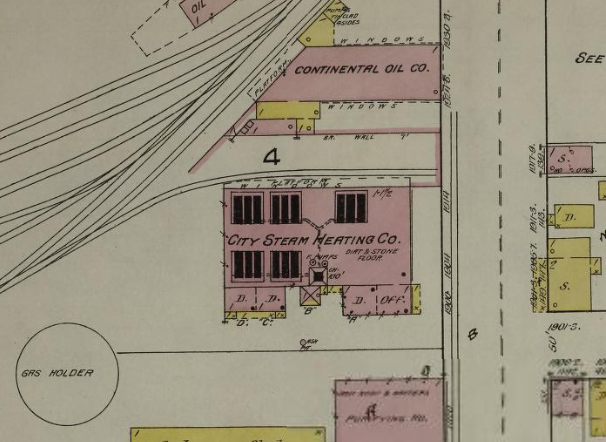
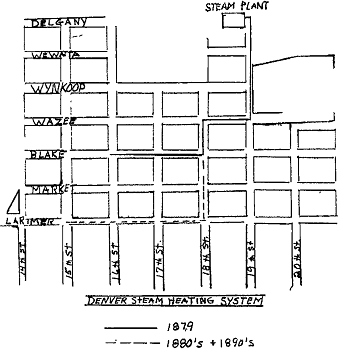
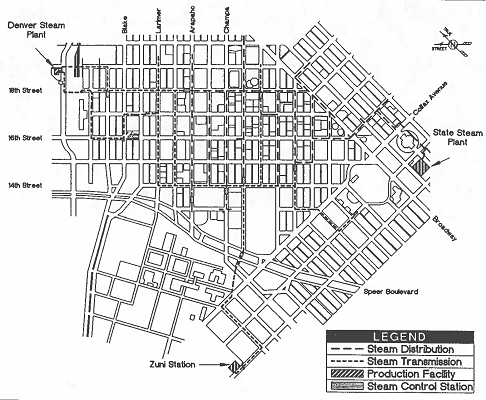
| 1887 Denver City Steam Company | 1879 Steam Map | 1994 Steam System Map |
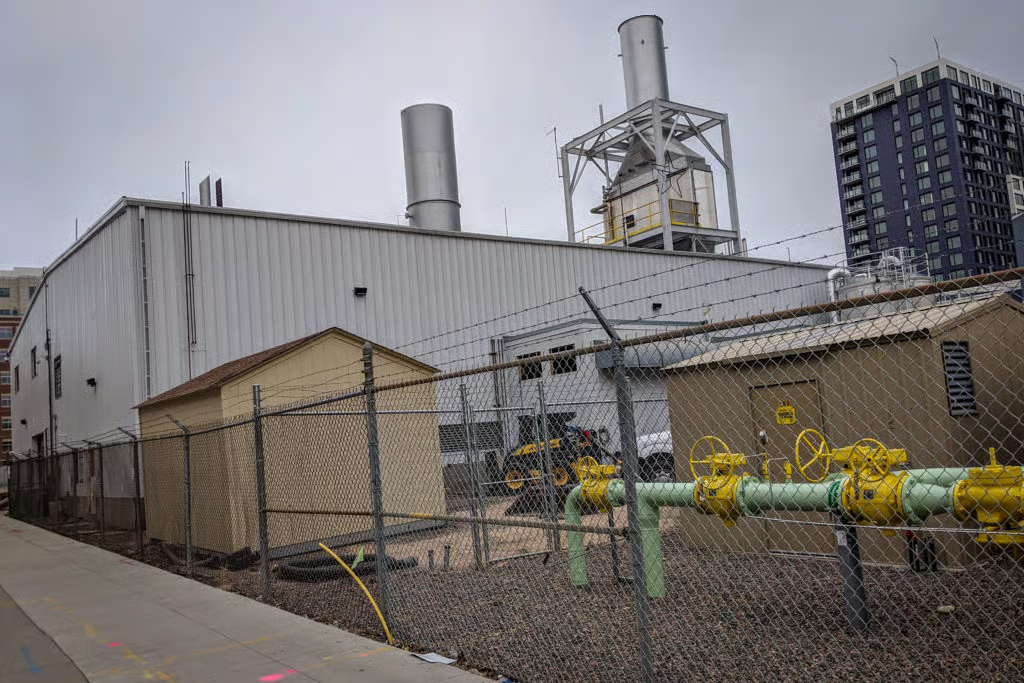 |
| Denver Steam Plant in 2019 |
The Denver City Steam Heating Company was organized in December 1879 by John Wesley Smith and others. The company began supplying steam on November 5, 1880 The company was bought by the Denver Gas and Electric Company in 1909, which became part of the Public Service Company of Colorado.
The Denver system became the oldest operating district steam system in the world on June 15, 1969 after the shut down of the system in Lockport.
Also see History of Denver's Waterworks
References
1858 "The
New Eldorado," Kansas City Journal of Commerce, August 16,
1858
1858 "Very
Latest News from the Mines," Council Bluffs Weekly Bugle,
November 24, 1858, Page 2.
Five Hundred and Sixty Miles from Council Bluffs!
Mr. Ricthman [Riethmann] who went out with the Council Bluffs train to the
South Platte Gold Mines, returned on the 23d inst., being only EIGHTEEN
DAYS out from the mines, and brought back from forty to fifty letters from
the boys in the mines, so their friends in this place.
He also brought back about twenty dollars worth of the "Dust." He
arrived at the mines on 30th October, and left on the 5th November.
1858 The gold mines of western Kansas, by William B. Parsons, December 1858
1859 Hand
Book to the Gold Fields of Nebraska and Kansas: Being a Complete Guide
to the Gold Regions of the North and South Platte, and Cherry Creek
... ; Containing Narratives of Trips to and from the Gold Region in
the Years 1858-59, by William Newton Byers and John H. Kellom
Page 4: 34 (Page 102, second line from bottom of page). This
was John J. Riethmann, later a prominent business man of Denver. This
report appeared in the Council Bluffs Bugle of November 24, 1858.
Pages 102-103: Reprint of November 24, 1858 Council Bluffs Bugle article
about Mr. Ritchman [Riethmann] returning from the Colorado mines with
twenty dollars' worth of gold dust.
1860 An act to incorporate the Capitol Hydraulic Company of Arrapahoe County. February 21, 1860.
1861 "Editorial
Correspondence," The Rocky Mountain News, February 16, 1861,
Page 2.
We were forcibly struck with the great destruction of timber in this
neighborhood within the past two years. Of the fine forests that covered
the hill sides in the Spring of ’59, full two-thirds has now entirely
disappeared, and a majority of the steam mills —the greatest consumers of
fuel —have not yet been running twelve months. We can see no prospect
ahead but a certain and great scarcity of timber, with which to carry on
the mining operations of the country in this immediate vicinity. Vast
quantities are used about the steam mills; for timbering up shafts and
drifts ; and in the thousands of huge fire-places by which the habitations
of the miners and others are warmed. In another year wood must be hauled
for miles, and its cost thereby increased more than a hundred per cent.
1867 An act to change the name of the Capitol Hydraulic Company. January 10, 1867. Shareholders authorized to change name to Platte Water Company.
1869 "The
Kansas Pacific Railway," The Rocky Mountain News, May 17,
1869, Page 1.
Our conviction that the expenses of the road will be considerably reduced
on reaching Denver, are founded greatly on the fact that of the entire
running expenses for 1868 nearly one fourth was for fuel. This was wood,
much of it inferior, purchased at high rates at different points along the
road, or transported at heavy cost from the timbered district near the
Missouri river. By using the coal found near Denver or Cedar Point, it is
estimated that, as it can be distributed along the line eastward at the
company’s convenience and with scarcely any expense except loading, a
saving of 75 per cent, may be gained in this item.
1874 "City
and Vicinity," The Rocky Mountain News, February 27,
1874, Page 4.
The marriage of Mr. Henry M. Porter in this city, a day or two ago, has
already been announced in THE NEWS, and the many friends of that
gentleman, hereabouts, have, no doubt, been rejoiced to hear of the
pleasant event. Mr. Porter, who now controls several extensive mercantile
establishments in New Mexico, making his home at Elizabethtown, is known
in this territory as one of the earliest as well as most successful
business men in Denver. His wife, nee Laura Smith, was one of the
belles of our city, and has won the high esteem of all by her high social
qualities. We unite with the hosts of friends of the happy couple
extending congratulations upon the union.
1879 "How
a Whole City can be Heated," American Machinist 2(4):5
(February 15, 1879) | also here
|
1879 "The Holly System of Steam Heating," American Machinist 2(4):8 (February 15, 1879) | also here |
1879 "Heating
by Steam," The Rocky Mountain News, November 18,
1879, Page 5.
The Holly System to be used in Denver.
Endorsement of the Plan by the American Machinist.
Its Success in the States.
Nature of Plan and Interesting Details.
Combination is the rule of the day. It includes not only governments,
railroads, armies, express lines and telegraph companies, but descends to
the small economies of daily life. Light and water have long been
distributed on the combination plan by the aid of machinery and pipes, and
now heat has its turn and the turn includes Denver. For the purpose of
introducing the Holly combination system for heating towns and cities by
steam, Messrs. E. D. Parsons, of this state, and It. W. Bissell, of
Lockport, New York, have taken rooms at a leading hotel, and are talking
up the project in a business-like way. The system is already in use in
Springfield (Massachusetts), Troy, Lockport (New York), Detroit and
Milwaukee, and, under the supervision of General Spinola, will soon have a
foot-hold in New York city. From all of those cities the most flattering
reports arie received, and the general wonder expressed that this manifest
convenience was not thought of before. For the information of the Denver
public, who will be invited in due time to act in the matter, an article
from a recent issue of the American Machinist, a New York publication of
standard worth, is given below. [Rush Walworth Bissell of
Lockport and Elizur Dwight Parsons, a Colorado Springs lawyer]
1879 "Heating
the city by steam," The Rocky Mountain News,
December 16, 1879, Page 8.
Formation of a Stock Company of Local Capitalists for that Purpose.
Articles of incorporation of the Denver City Steam heating company were
filed in the secretary of state’s office yesterday. The
incorporators and directors are George Tritch, Erastus F. Hallack, Leonard
H. Eicholtz and John W. Smith. At a meeting of the directors last evening
the following officers were elected: President — John W. Smith. Vice
President — E. F. Hallack. Treasurer— George Tritch. Chief Engineer — L.H.
Eicholtz. Attorney —J. W. Horner. Secretary — Charles H. Smith.
The chief engineer and secretary will go east in a few days to examine
more thoroughly the practical workings of the works in Milwaukee, Detroit,
Lockport and a few other cities where steam is now used quite extensively,
and to gather such other information and data as may facilitate the
erection of works and the laying of pipes.
1880 History
of the city of Denver, Arapahoe County, and Colorado, by
William E. Vickers
Pages 556-557: John J. Riethmann
Pages 589-591: John W. Smith
1880 Steam Heating Franchise to Denver City Steam Heating Company, January 5, 1880, Franchises and Special Privileges of the City and County of Denver (1907), Page 349.
1880 "Notice,"
The Rocky Mountain News, January 7, 1880, Page 7.
The Denver City Steam Heating company is now ready to receive
subscriptions to part of the capital stock of the company. Residents of
Denver desiring to subscribe can now do so by calling at the company’s
office, 401 Blake street, on or before the 10th inst., from 10 a.m. to 4
p.m. J. W. Smith. President. Denver, Colorado, January 6, 1880.
1880 "Going
East to Inspect," The Rocky Mountain News, January 15, 1880,
Page 8
By this morning’s Kansas Pacific express, Mr. Charles H. Smith will take
his departure for the east in the interest of the Denver Steam Heating
company. He will be absent six weeks and will visit Chicago, Milwaukee,
London (Canada), New York city, Lockport, Springfield, and other points
where the system is in use, for the purpose of noting the latest
improvements. Of the capital stock assigned to Denver —$100,000— nearly
all has been taken, and negotiations are now under way for a suitable
location for the plant, with the expectation of breaking ground very early
in the spring.
1880 "Cities
Heated by Steam," The Daily News (Kingston, Ontario),
January 23, 1880, Page 3. [This is probably the account of Charles
H. Smith of Denver, who recently visited Lockport, Detroit and London]
It may be interesting to shew the estimation in which the system is held,
in the United States generally, by citing the amounts paid by few of the
chief cities for the right to adopt the system, viz. : New York and
Brooklyn, $300,000; Baltimore, $65,000; Chicago, $100,000; Cincinnati,
$50,000; New Haven, with a population of 60,000, paid $18,000; Toledo,
with a population of 40,000, $12,000; Syracuse, 45,000 of a population,
$12,000, &c. In some instances pipes have been laid in certain towns
without the supervision of competent persons; the result has been the
breaking of joints from the expansion not having been attended to; but
when properly laid a small expenditure should be necessary for at least
the first 20 years.
1880 Lockport
Daily Journal, January 26, 1880, Page 4. | also here
|
J. W. SMITH, Esq., President of the Denver steam heating company, is in
the city on business.
1880 "Heating by Steam. Present Aspects of the Proposed Improvement. The Council Liable to Grant a Modified Privilege. Exclusive in Nature but Limited to a Term of Five Years," Rocky Mountain News, January 28, 1880, Page 8.
1880 Letter from Charles
Smith, Denver Tribune, January 28, 1880, Page
Visit to Detroit
1880 Letter from Charles
Smith, Denver Tribune, January 31, 1880, Page
Visit to London, Ontario
1880 "Cities
Heated by Steam," The Daily News (Kingston, Ontario),
January 23, 1880, Page 3. [This is probably the account of Charles
H. Smith of Denver, who recently visited Lockport, Detroit and London]
It may be interesting to shew the estimation in which the system is held,
in the United States generally, by citing the amounts paid by few of the
chief cities for the right to adopt the system, viz. : New York and
Brooklyn, $300,000; Baltimore, $65,000; Chicago, $100,000; Cincinnati,
$50,000; New Haven, with a population of 60,000, paid $18,000; Toledo,
with a population of 40,000, $12,000; Syracuse, 45,000 of a population,
$12,000, &c. In some instances pipes have been laid in certain towns
without the supervision of competent persons; the result has been the
breaking of joints from the expansion not having been attended to; but
when properly laid a small expenditure should be necessary for at least
the first 20 years.
1880 "The
Holly Steam Plan," The Rocky Mountain News, February
5, 1880 Page 8.
General outline of proposed Denver system. Twenty-Three Thousand Feet of
Pipe Will Be Used.
The Plant to Foot Up One Hundred Thousand Dollars.
Obvious Advantages of Cooking in Steam Stoves.
Use of the System in Connection With Fire.
When Solomon, weary with “taking in the town” and other affairs of state,
exclaimed in a moment of surfeited ennui, “There’s nothing new under the
sun,” he formulated a section of truth that applies with peculiar emphasis
to the Holly system of heating cities by steam, successfully introduced at
Lockport, New York, as long ago as 1877, when three miles of experimental
pipe were laid in that favored locality, the home and nursery of rare
mechanical genius, and the abiding place of as many ideas to the square
foot as Boston can prove parentage to theories or Denver to corner lot
schemes, to say nothing of mining discoveries with millions in them. All
this aside, Birdsell Holly’s
STEAM-HEATING PROCESS
is moving rapidly towards general adoption, being helped thereto by
undoubted success in such cities as Milwaukee, Auburn, Detroit and Troy.
Twenty-two cities, exclusive of Denver, will this year put in the system.
In the list are Cincinnati, Brooklyn and New York. The latter metropolis
will make use of three hundred miles of main pipe inside of four years,
and has provided for four boiler stations of one hundred and five boilers
each, enough to make a memorable blow up were it not for the precautions
adopted by the Holly company, whose boilers, of the best United States or
steel plate makes, are tested for one hundred and fifty pounds to the
square inch but never pushed beyond fifty. While the general phase of the
topic is in hand it may be well to observe that the Holly Steam Heating
company is a Lockport institution and that more than one thousand
mechanics are now employed at their works, in filling the orders for
appliances already received since January 1. The annual election of the
company took place in Lockport, January 21, and, as reported in the
Union, resulted as follows :
THE MAIN ORGANIZATION. Directors — D. F. Bishop, B. D. Hall, R. Scott, J.
H. Babcock, B. Holly, L. Everett and S. Rogers.
After the election of the directors the following officers were chosen :
President— D. F. Bishop. Vice President— R. Scott. Secretary — B. D. Hall.
Treasurer — I. H. Babcock. Consulting Engineer— B. Holly. Superintending
Engineer— E. P. Holly.
“The company,” says the Union, “is probably the best business
investment ever inaugurated in Lockport. The profits for the past year on
a capital of $25,000 are virtually $213,000, of which $153,000 are paid
in. Of the net profits the inventor of the system, B. Holly, receives ten
per cent.”
By reference to the personal paragraphs in yesterday’s issue of The News
it will be seen that Mr. E. P. Holly, consulting engineer of the company
under notice, is now in this city, called hither by the management of the
Denver Steam Heating company, a combination of local enterprise and money
that is standing a prolonged siege from the legal portion of the city
council, and which is making vicarious atonement for all the sins of
omission, commission and miscalculation that are usually charged against
corporate bodies under the rallying cry of war on monopoly. Mr. Holly is
stopping at the American, and thither went a commissioner of The News for
the purpose of a practical talk on the Denver plan. The conversation
proceeded :
THE ENGINEER TALKS.
"Mr. Holly,” said the commissioner, “ I learn that you have been called
here to prepare the plans for the Denver steam-heating system ? ”
“ Your information is correct,” said the consulting engineer, at the same
time spreading out a series of maps and sketches.
An examination of these papers, neatly and accurately drawn, shows the
location of the “plant” on Delgany street, at the foot of Sixteenth. By
“plant”is meant a brick building capable of holding twenty boilers, but
which, until the proposed system is extended, will be occupied by six.
From Delgany up Sixteenth to Larimer the plan provides for the laying of
2,400 feet of eight-inch wrought-iron pipe, lap-welded and wrapped with
asbestos and other non-conducting material. From Larimer up Sixteenth to
Champa, the southern boundary of the present district, the main will be
six inches in diameter and 1,600 feet long.
On Larimer again 2,400 feet of six-inch pipe will be laid, extending from
Nineteenth street on the east to Fourteenth on the west, where the West
Denver connection, to be laid in due time, will connect and cross at the
Larimer Street bridge.
On Nineteenth street 1,500 feet of six-inch pipe will be laid up to
Champa, and from the intersection of Nineteenth and Champa to Sixteenth
and Champa this six-inch main will be continued 1,500 more, to a
connection with the Sixteenth street main. This will surround the
NEW HEART OF THE CITY
with six-inch pipe to keep its projects from freezing, including the
proposed court house, city hall, opera house, federal building,
post-office, etc., etc.
Dropping down to Wazee the line of six-inch main runs from Sixteenth west
to Fifteenth, thence to Blake, thence to Fourteenth and thence to Larimer,
where it joins the West Denver pipe. This involves the use of 1,600 feet.
Up Fourteenth to Champa the way is mapped out for 1,400 feet of four-inch
pipe. From Nineteenth to Fourteenth, on Arapahoe street, and from
Sixteenth to Fourteenth, on Champa, the void is filled up with 3,400 feet
of the four-inch pipe, while Lawrence and other intermediate streets are
supplied from 4.000 feet of three-inch pipe and 3,200 feet of pipe two and
one-half inches across.
This piping sums up in feet:
Eight-inch main 2,400
Six-inch main 8,600
Four-inch main 4.800
Three-inch pipe 4,000
Two and one-half inch pipe 3,200
Total number of feet 23,000
This, together with the boilers and building, involves an immediate
expenditure on the part of
THE DENVER COMPANY
of $l00,000, together with the employment of a large number of men.
“Suppose a customer was located at the corner of Nineteenth and Champa,
what are his chances for heat ? ” the commissioner asked.
“As good,” said the engineer, “as if his house was on Delgany, within
sight of the boilers. The loss of pressure in one mile equals four pounds
to the square inch, and this we offset by gauging the distant customer at
ten pounds pressure while the near customer is gauged at six.”
“As distance is added, then, you increase the boilers and put on more
pressure? ”
“Yes, the building planned now will do for several more mains. The loss of
heat, you know, is not at all in proportion to loss of pressure. The
latter is perceptible only where customers take steam for motive power.”
“Then the Denver system includes manufactures ? ”
“Every purpose for which steam can be used, from running a planing mill
down to boiling an egg.”
“Or spoiling a beefsteak ?”
“No, that’s one advantage about steam cooking. Let me call your attention
to an item in the Lockport Journal of September 4, 1879.”
The commissioner did not resent this attention raid, but for the better
information of his readers presents this extract from the journal called
up:
COOKING BY STEAM.
One of the most remarkable features of the present age is the large number
of useful and labor-saving inventions which have been brought into
practical use. Prominent among which, for utility and comfort, must be
classed the Holly system of steam heating. * * * To be used in connection
with this system, Mr. John Ashcroft, of New York city, has invented a
patent steam stove and broiler, which answers the purposes for which it
was designed, and is ultimately destined to come into general use wherever
the system of steam heating is in vogue. It is not so much our purpose in
this article to speak of the style of the apparatus, which will be of
various patterns to suit all classes, as to speak of the merits of this
stove, which has already stood the tests of connoisseurs and practical
scientists, who thoroughly understand such business, ail of whom were
surprised at the manner in which the cooking was done, and conceded that
it is especially designed for the purpose for which it is to be used.
Yesterday, in this city, an exhibition and trial of the cooking qualities
of this stove and broiler were made in the presence of about twenty-five
or our best-known citizens, prominent among whom were Birdsall Holly
(inventor of the Holly steam-heating system), Harvey Gaskell
(superintendent ot the Holly Water Works company), Barnet D. Hall
(secretary of the steam heating company), Leroy Chadwick and William
O’Keefe. * * * With the steam pressure ranging from nineteen to
twenty-seven pounds to the square inch, or an average of about
twenty-three pounds pressure, the roast beef was finely carbonized or
browned, and was remarkable for its justness and
THE DELICIOUS FLAVOR
it retained. The chickens were browned, very tender and of fine flavor.
The white potatoes were both mealy and well baked. The ham, which was
broiled in the short space of three minutes, instead of being hard when
cold, remained soft and juicy. The mutton chops and beef steak were
especially commented on for their tenderness and fine flavor. A loaf of
bread was baked in the oven in the short space of forty minutes, and when
taken out it had a good brown crust — but what was more remarkable, the
bread was returned to the oven and allowed to remain there one and
one-half hours without being injured in the slightest particular. The
coffee was boiled in one of Mr. Ashcroft’s patent pots in about ten
minutes, without losing any of its aroma. * * * This cooking by steam is a
wonderful improvement upon the ordinary mode, and cannot help but come
into general use. * * * By means of this stove and broiler the meats,
vegetables, etc., can be either fried, broiled or baked without being
scorched, and no food can be spoiled from over cooking. Food which
generally emits an unpleasant and offensive odor in cooking, by the
ordinary methods, can be prepared for eating, by this process, without
emitting the slightest disagreeable smell. Mr. John Ashcroft’s patent will
prove a blessing to the already over-burdened housewife, by lightening her
labors, and doing away with many of the onerous difficulties incident to
preparing food by the common methods. * * * This morning an exhibition was
given to a number of ladies of this city, who have the Holly steamheating
system in their buildings, which met with general satisfaction.
PRESIDENT SMITH ON THE STAND.
At this point in the proceedings Mr. John W. Smith, president of the
Denver Steam Heating company, walked into the room, and from him the
commissioner gleaned :
“ Well, how is the steam stock going ?”
“It’s about half taken,” said the wary president—“ we can sell the rest
when the council gives assurance that the enterprise will not be hampered
with immediate competition.”
“ Then, if the council comes to time, you will be ready for work?”
“ Yes, we want to commence early in the season, to give the new houses a
chance. If the council will give us the protection we ought in reason to
get for a new enterprise of this bulk, we will give Mr. Holly the contract
and have the works put up and the pipes laid in first-class style. We aim
to make no mistakes.”
The use of the term “ mistakes ” led the commissioner to think of breaks,
etc., and to set his mind at rest he questioned the engineer :
“ Suppose a break occurs in your mains, or you want to let in a new
customer, must all the rest wait for dinner or complain of the cold ?"
“Not at all. The system laid down here (pointing to the chart) has
thirty-nine sections of pipe, each independent of the other. In the class
of material we use breaks seldom or never take place, and if we want to
let in a new customer the process is completed in
LESS THAN TEN MINUTES,
before the pipes in the houses on that section have time to cool.”
“Can this steam be made useful in case of fire?”
"That is one of its obvious good points. By the use of a little
contrivance, which takes up small room, an apartment can be instantly
flooded with steam, and that, as you know, will put out any fire quite as
quickly as water and with far less damage.”
Thinking this a good point to stop at and one well worthy of consideration
from the council and the property-owners of Denver, the commissioner
withdrew.
1880 Letter from Charles H. Smith about steam heating in Detroit, Denver Tribune, January 28, 1880. No copy of this has been found.
1880 Letter from Charles H. Smith about steam heating in London, Ontario, Denver Tribune, January 31, 1880. No copy of this has been found.
1880 "Heating
by Steam," Letter from Charles H. Smith, Denver Tribune,
February 10, 1880, Page 6.
Visit to Troy and Lockport.
Of all the places I have visited, Troy is the nearest to perfection and is
obtaining better results from consumption of coal then even the Lockport
company is. Everything is systematized, a record of every pound of
coal consumed and every pound of water evaporated.
1880 "The
Steam Heating Project," The Rocky Mountain News,
February 24, 1880, Page 8.
While Birdsill Holly, superintendent of the Lockport Steam Heating
company, was here a few days since, he made a proposition, subject to
approval by his company, to furnish all the material and lay four miles of
main pipe, the work to be commenced in May and to be finished in August of
this year. The Denver company will accept Mr. Holly’s proposition as soon
as a sufficient amount of its capital stock is subscribed to justify the
undertaking. The company have purchased, conditionally, ten lots of
ground near the gas works, on which to erect the boiler station of the
middle district.
1880 "The
Holly System," Kansas City Weekly Journal, March 25, 1880,
Page 8.
Mr. E.P. Holly, superintendent of the Holly Steam Combination Company.
Denver is one of twenty-seven cities where the system is to be established
this season.
1880 "Steam
Heating," The Rocky Mountain News, April 7, 1880,
Page 8.
Preparing for Commencing Operations at Once. The Works to be Completed and
In Use by Next Winter.
1880 "A
Two-Mile Contract," The Rocky Mountain News, April 25, 1880,
Page 4.
At a meeting of the directors of the Denver City Steam Heating company,
held yesterday, a contract was awarded to D. F. Bishop, of Lockport, Ohio,
for laying two miles of pipe for the company.' Work will begin at once,
and as a member of the company said to a News reporter last night, "it
remains with the public to say whether more extensions shall not be
immediately inaugurated."
1880 Lockport
Daily Journal, May 1, 1880, Page 4. | also here
|
A contract was signed Saturday evening by the President of the Holly Steam
Combination Company, of Lockport, N. Y., and the Denver City Steam Heating
Company, by which the former company agrees to furnish and lay two miles
of main pipe for the use of the latter. According to the terms of the
contract the pipe is to be all laid by the latter part of August, and if
the citizens of Denver come forward and subscribe liberally to the stock
of the Denver company, a further contract will be made for the laying of
two miles additional.— Denver Tribune, April 27th
1880 The
Rocky Mountain News, May 11, 1880, Page 8
The Denver City Steam Heating company commenced excavating for the
foundation of their large boiler station depot to-day near the gas works.
William Egerer has the contract for the stone foundation, and will
commence laying stone to-morrow. The building will be 75 feet by 140 on
the ground; the walls above ground will be brick, and with a brick smoke
stack 75 to 100 feet in height, large enough to receive the smoke from
twenty-four boilers of 100 horse power each. The depot is to be finished
early next month, at which time the company will commence laying the main
pipes in the streets of Denver.
1880 "The Denver Steam Heating Co is pushing its work rapidly," The Plumber and Sanitary Engineer 3:234 (May 15, 1880)
1880 Lockport
Daily Journal, June 15, 1880, Page 3.
Next week the Holly Steam Company will ship several car loads of material
to Denver, CoL The system will be put in operation in the above city with
all possible dispatch.
1880 "The Steam Heating Works," The Rocky Mountain News, July 2, 1880, Page 5.
1880 “Colorado
as Seen by a Visitor of 1880,” by Rezin H. Constant, Colorado
Magazine, 12(3):111 (May 1935)
August 5, 1880. An immense building is being erected and well along,
at the foot of 16th for heating the City by Steam
1880 "Progress of Steam Heating," The Rocky Mountain News, September 3, 1880, Page 1.
1880 Weekly
Register Call, September 17, 1880, Page 1
The charge for heating rooms by the new Steam heating company at Denver,
will be $5 per year for each 1,000 cubic feet of space. This manner of
assessment, however, will be only temporary. When the company has
everything in full working order, steam meters will be put into each
building.
1880 "Heating
by Steam," Denver Tribune, November 4, 1880, Page 8
Radiators have been placed in the American House and President Smith's
office, and the steam will be turned into them today or tomorrow, which
will be the first practical demonstrations of the workings of the heating
apparatus in this city.
1880 The
Rocky Mountain News, November 10, 1880, Page 8.
The success of the Holly steam heating works in this city is an
established fact, both for heating purposes and for running machinery in
all parts of the city. The pipes have been connected with the engine at W.
J. Kinsey’s, and the remit exceeds their brightest anticipations. Although
the connection is made near the dead end of the pipe, everything runs
smooth as clockwork, the pressure scarcely varying a degree since the
connection was made. Safety and economy will lead many to adopt this
system.
1880 "Heating
Cities by Steam," Chicago Tribune, November 13, 1880, Page
14.
A Successful Test of the Mains in Denver. Denver Tribune, November
6
1881 "The
Steam Heating Company," The Rocky Mountain News," January 1,
1881, Page 6.
Active operations were not begun, however, until last spring, when the
work of laying the pipes and the erection of boilers, boiler houses, etc.,
was undertaken. The mains laid to this time, in feet, amount to 10,829,
and they run through the following streets: From the boiler house up
Eighteenth to Blake, down Blake to Fifteenth, down Fifteenth to W. J.
Kinsey’s; on Sixteenth street from Blake northward 200 feet are laid; up
Fifteenth to Curtis, and on Curtis from Fifteenth to Sixteenth; on
Lawrence from Fifteenth to Seventeenth; on Larimer from Fifteenth to
Seventeenth; on Seventeenth from Larimer to Lawrence; on Holladay from
Fifteenth to Sixteenth. Steam was turned on in the middle of November.
There are now about fifty consumers, with hundreds more to follow, and all
seem well satisfied. The system is represented as perfect. Seven engines,
of a total of forty horse power, are in use.
1881 Crofutt's
Grip-sack Guide of Colorado: A Complete Encyclopedia of the State:
Resources and Condensed Authentic Descriptions of Every City, Town,
Village, Station, Post Office and Important Mining Camp in the State,
by George A. Crofutt, January 1881
Page 32: The Denver City Steam Heating Co. was incorporated December 15th,
1879, to supply steam by the Holly system or any other to heat dwelling
houses, stores, shops, factories, and other buildings, and for motive
power to run machinery and other purposes. The company's works are located
near the Platte River and gas works, foot of 18th street, are of brick;
they have six 300-horse power boilers, and over two miles of pipe laid
from their works. Steam was first turned on November 5th, 1880, and was a
success from the start. The American Hotel, several engines and many
offices are using the steam and declare it to be a great saving. The
company have ordered more pipes, and they will be laid and the steam
supplied in all parts of the city as soon ss possible. The company has a
capital stock of $500,000, and $100,000 has already been expended in their
works and business. We notice among the incorporators J. W. Smith,
Geo. Tritch, and E. F. Hallack. pioneer names in Colorado twenty years
ago. These men have made their fortunes in the State, and are now all
using it to introduce a steam heating system at once ample, cleanly,
pleasant, always ready and cheap.
1881 The
Rocky Mountain News, September 16, 1881, Page 8.
The pipes of the steam heating company are being extended out Sixteenth
street to California.
1881 The
Rocky Mountain News, October 4, 1881, Page 2.
A large number of workmen in the employ of the steam heating
company are engaged in extending the pipes up Larimer to
Eighteenth. From the corner they will be laid down the latter street to a
point about midway between Holladay and Blake, where they will connect
with the line already in place from Blake to the spot indicated.
1881 "A
Half-Million Mortgage," The Rocky Mountain News," October
16, 1881, Page 8.
A mortgage to mature September 1, 1901, was filed by Kassler &
Eicholtz in the county clerk’s office yesterday. The mortgage is given by
the Denver Steam Heating company upon all its real and personal property,
to secure the payment of 500 of the company’s bonds for $l,000 each, and
bearing six per cent per annum interest.
1882 Corbett
& Ballenger's 10th Annual Denver City Directory, February
1882
Page 56: Denver City Steam Heating Co.--E.F. Hallack, President;
W.J. Kinsey, Managing Director; George Tritch, Treasurer; J.D. Bushnell,
Secretary. Office 471 Holladay
1883 Corbett &
Ballenger's 10th Annual Denver City Directory, February 1883
Page 58: Denver City Steam Heating Co.-J.J. Riethmann, President;
W.J. Kinsey, Treasurer; Henry Suhr, Secretary; William Ridley,
Superintendent. Office, Larimer, northwest corner Fifteenth.
1884 Corbett
& Ballenger's 12th Annual Denver City Directory. March,
1884
Page 63: Denver City Steam Heating Co.--J.J. Riethmann, President;
F.G. King, Vice-President; W.J. Kinsey Treasurer; Gustav Krause,
Secretary; William Ridley, Superintendent. Office, Larimer,
northwest corner Fifteenth.
1884 "The
Distribution of Steam in Cities," by William P. Shinn, Vice
President New York Steam Company, Transactions of the American
Institute of Mining Engineers 12:632-638 (February 1884) | also here
|
Page 631: In Denver, Colorado, the system has been in use during
four years, for heating only. The company has nearly three miles of eight,
six, four and three-inch mains, and fifteen 50 horse-power boilers,
supplying 150 consumers. Upon an investment of $150,000, the company
earned net, during the season of 1882–83, $7863, or 5 ²⁄₁₀ per cent., and
the net savings for the season of 1883-84 were estimated at $10,000, or 6
⅔ per cent.
1885 Corbett
& Ballenger's 13th Annual Denver City Directory, March
1885
Page 64: Denver City Steam Heating Co.--J.J. Riethmann, President;
F.G. King, Vice-President; W.J. Kinsey, Treasurer; Gustav Krause,
Secretary; William Ridley, Superintendent. Office, Larimer,
northwest corner Fifteenth.
1885 "Denver
Digested," The Rocky Mountain News," May 3, 1885, Page 6.
The Denver Steam Heating company has been in operation three years,
drawing its surplus of water from an artesian well on the premises; has
fifteen boilers seventeen feet long, five feet diameter, and three
Worthington duplex pumps; has 1,540 feet of eight-inch main pipe, 4,968
six-inch. 5,094 four-inch and 3,400 feet of three-inch, or a total of
15,002 feet of main and two miles of service pipe, varying from 1 to 24
inches in diameter, laid to consumers. PRESENT VALUE OF THE PLANT,
$150,333 64.
1886 Corbett
& Ballenger's 14th Annual Denver City Directory, March
1886
Page 67: Denver City Steam Heating Co.--J.J. Riethmann, President;
W.J. Kinsey Treasurer; Gustav Krause, Secretary; William Ridley,
Superintendent. Office, Larimer, northwest corner Fifteenth.
1886 "The
Steam Men," Lockport
Daily Journal, June 15, 1886, Page 3.
National Convention of Steam Engineers and Superintendents of Companies
Held in this City To-day.
Wm. Ridley, Denver, Col.
1886 "The
Second Days Meeting of the Steam Engineers," Lockport
Daily Journal, June 16, 1886, Page 3.
Vice-Presidents—William Ridley, Denver, Col.
1887 Corbett &
Ballenger's 15th Annual Denver City Directory, March 1887
Page 67: Denver City Steam Heating Co.--J.J. Riethmann, President;
W.J. Kinsey Treasurer; Gustav Krause, Secretary; William Ridley,
Superintendent. Office, Larimer, northwest corner Fifteenth.
1887 "Men
of Steam," Altoona Times, June 16, 1887, Page 1.
Williamsport, June 15. The annual session of the Holly District Steam
Engineers, Superintendents and Managers' Association opened here to-day
with a good attendance. The organization is devoted to matters connected
with steam supply interests and represents the majority of the States in
the Union. President Foreman, of this city, presides. Reports were
presented today by the Secretary and Treasurer. Various papers will be
read to-morrow.
1887 Sanborn
Fire Insurance Map from Denver, Denver County, Colorado (1887)
Plate 15: Denver City Steam Heating Company
1888 The
Denver Exchange Journal, February 11, 1888, Page 3.
Denver enjoys the distinction of possessing one of the most successful
steam heating concerns in the United States. The Denver Steam Heating
Company has a nest of fifteen boilers, averaging 120-horse power each,
which consumes daily, ninety tons of lignite coal, and evaporates from
150,000 to 200,000 gallons of water in the same period. The insulation is
almost perfect, and the loss by condensation reduced to a small per cent.
During the past year the company has been utterly unable to meet the
public demand, and have been voted to double their capacity. The net
profit to the company during the past year was 12 per cent on a capital of
$120,000. The company is to be congratulated in having such an efficient
manager.
1888 Corbett &
Ballenger's 16th Annual Denver City Directory, April 1888
Page 71: Denver City Steam Heating Co.--J.J. Riethmann, President;
W.J. Kinsey Treasurer; Gustav Krause, Secretary; William Ridley,
Superintendent. Office and works, Nineteenth street, between Wynkoop
and Wewatta street.
1888 "Holly
Steam Engineers," Engineering News 19:543 (June 30, 1888)
The Holly District Steam Engineer's, Superintendents' and Managers
Association held its third annual convention at Springfield, Mass. June
22, and elected the following officers:
President, R. H. GALLAGHER, Harrisburg, Pa.: First Vice-President, C. E.
EMERY New York; Second, E. P. HOLLY, Springfield, Mass. Third, G. W.
SHOUCK, Wilkesbarre, Pa.: Fourth, WILLIAM RIDLEY, Denver, Col.; Secretary,
IRA A. HOLLY, New Haven; treasurer, ROBERT MOWBREY; Financial Committee,
A. Z. SHOCK, Bloomsburg, Pa., J. D. WALSH, of Lockport, N.Y., and A. D.
MERRITT, Springfield.
The following papers were read and discussed: "High and Low Pressures for
Heating Buildings from a Central Station", by R. H. GALLAGHER, Harrisburg.
Ha.: "Crude Oil and Coal Compared as Fuels", by E. P. HOLLY; "Can Cooking
be done economically by Steam?" by CHARLES S. CHASE, New York: "General
Management of the Holly Steam Plants”, by A. Z. SCHOCK, Bloomsburg:
"Incrustation in Boilers", by WILLIAM RIDLEY, Denver, Col. “Is it
Advisable to Heat Feed Water by Direct Steam" by B, C. SMITH, Auburn, N.
Y.: "Cost of Maintaining Steam Meters" by JOHN WALSH, Lockport, N. Y.;
"Saving Fuel by the Automatic Regulation of the Damper", by N.C. LOCKE,
Salem; "Combustion of Fuel and Boiler Furnaces", by THOMAS MURPHY,
Detroit, Mich.; "Rocking Grate Bars", by C. B. HOLLY, Phillipsburg, Pa.
1888 The
Manufacturer and Builder 20:214 (September, 1888)
Transactions of the Holly District Steam Engineers, Superintendents and
Managers' Association during the Year 1887. New Haven, Conn.: Geo.
W. Moffatt. 1888.
The above-named pamphlet contains the transactions of the second annual
meeting of the superintendents, chief engineers and managers of the Holly
District Steam Supply companies of various cities throughout the United
States, which was held at Williamsport, Pa., June 15-16 of the present
year. It embraces papers on Piping Buildings for Steam Heat, by Geo.
S. Chase, of Bellefonte, Pa.; The Most Economical Way of Generating
steam-the size and Kind of Boilers, by Wm. Ridley, of Denver, Col.; On the
Rating of the Horse-Power of Steam Boilers, by W. P. Trowbridge, of New
York, and C. B. Richards, of New Haven, Conn.; besides a number of reports
upon subjects of technical interest to the members. The association
exhibits a commendable degree of activity, and will doubtless prove of
much advantage to its members as a means of mutual improvement.
1889 Corbett
& Ballenger's 17th Annual Denver City Directory, April
1889
Page 68: Denver City Steam Heating Co.--J.J. Riethmann, President;
W.J. Kinsey Treasurer; William Ridley, Superintendent. Office and
works, Nineteenth street, between Wynkoop and Wewatta street.
1889 "Steam
Heat Men," The Times Leader, June 21, 1889, Page 4.
Wm. Ridley, Denver, Col.
1889 "Briefs,"
The Rocky Mountain News, November 10, 1889, Page 3.
Orson S. Avery yesterday filed papers in the district court in a suit for
damages of $500 against the city of Denver and the Denver City Steam
Heating company. At the time the latter was putting down its pipes on
Nineteenth street it allowed a large upright boiler to stand in the
street. Avery claims that the horse he was driving took fright at the
obstruction and ran away, throwing him out and injuring him severely.
1890 "Annual
Meetings," The Rocky Mountain News, January 8, 1890, Page 6.
Yesterday afternoon the stockholders of the Denver Steam Heating company
met in their office, 1607 Blake street, and elected the following officers
for the ensuing year: President, H. M. Porter; vice president, E. F.
Hallack; treasurer, Joseph Thatcher; secretary, William Ridley; directors,
E. F. Hallack, Colonel L. H. Eicholtz, H. C. Brown, Moritz Barth and H. M.
Porter. The company has declared a dividend of 8 per cent. The gross
earning for the year were $38,500, of which $ll,000 was net. During the
year 25,000 feet of new pipe have been put in the ground and many of the
8-inch mains increased to 14 inches in diameter. A number of new boilers
have been added and the coming year will witness many changes and
improvements in the system of steam heating in the city.
1890 "Opinions
on Asphalt," The Rocky Mountain News, February 14, 1890,
Page 8.
Mr. William Ridley, Superintendent of the Denver Steam Heating
company, is probably the best informed man in the city to-day on
the subject of street paving.
1890 "The
Smoke Ordinance," The Rocky Mountain News, October 6, 1890,
Page 7.
That the black smoke which still pours from many chimnies in the city can
be stopped has been fully demonstrated at the Steam Plants of the City
Cable Railway company and the Denver Steam Heating company. The dense
smoke which once polluted the atmosphere has disappeared, to the intense
gratification not only of the above named companies but of every one who
was formerly compelled to breathe the smoke-laden atmosphere.
1890 "Fearful
Force," The Rocky Mountain News, December 17, 1890, Page 6.
An accident occurred at the works of the Denver Steam Heating company
yesterday which came near sending at least two men into eternity on short
notice. A gang of men, under the management of Contractor E. C. Cliff,
were engaged iu erecting a large boiler at the works. When they had it
within three feet of the upright position in which it is to stand a large
hook broke, letting the heavy shell of steel fail a distance of twenty
feet, crushing the corner of the building and badly injuring two men who
were employed there.
1891 Corbett &
Ballenger's 19th Annual Denver City Directory, April 1891
Page 78: Denver City Steam Heating Co.--H.M. Porter, President; J.A.
Thatcher Treasurer; William Ridley, Superintendent. Office, 1609
Blake; works, Nineteenth street, between Wynkoop and Wewatta street.
1892 "Public
Works," The Rocky Mountain News, November 30, 1892, Page 8.
Damages to tho street by Defective Steam Supply Pipes. Mclntyre &
Wickham made complaint to the board of public works yesterday, that the
pipes of the steam heating company on Eighteenth street, from Market to
Wewatta, were bursting and injuring the pavement, which the firm has
guaranteed to keep in repair for five years. A vigorous protest is
entered. The matter was referred to the city attorney.
1893 "Civil
Briefs," The Rocky Mountain News, October 20, 1893, Page 8.
James B. Shepard sues the Denver Steam Heating company for $3,000 damages
for neglecting to furnish steam for the block at 1643 Welton. On this
account the plaintiff was obliged to put in a heating plant after the
completion of the building, necessitating much expense.
1895 "Half
a Million," The Rocky Mountain News, January 16, 1895, Page
8.
Pipe Line Franchise Will Be Asked for the Introduction of Petroleum In
Denver. The Denver Heat and Light company made its first bow to the public
yesterday. For several months past the project has been slowly taking form
and the articles of incorporation were filed with the secretary of state
yesterday. The company is capitalized at. $1,000,000 and carries on its
list of members many of the leading business men of tne city. The primary
object of the new incorporation is to purchase the plant and franchise of
the Denver City Steam Heating company and extend its operations so as to
reach all parts of the city. At present the pipes of the steam plant are
found only in the streets of the district bounded by Blake and California,
Fifteenth and Nineteenth streets. The central station is located in the
Platte bottoms near the union depot. The company has been in operation
fifteen years and supplies heat to a number of the large downtown
buildings. The new incorporation will ask the city for a franchise
permitting it to extend its lines and to supply light and power as well as
heat. It is the purpose to utilize the steam pipes during the warmer
months, for the conveyance of oil for cooking, Illuminating and power
purposes. Under the present conditions, the plant produces but little
revenue during the summer. It is also proposed to construct a pipe line
from one of the leading oil fields for the purpose of supplying the city
with petroleum. The plans embrace the manufacture of fuel, coal from coal
dust and crude petroleum and it is contemplated that Denver shall be the
central point for distribution of the product. The directors of the
company are Thomas Mohr, J. A. Partridge, J. C. Feldwisch, F. E. Coe and
F. Cobb. George Tritch of the Tritch Hardware company, is a prominent
member of the company and has spent several weeks in negotiating the terms
of the sale of the heating plant. Mr. Tritch was seen last night and spoke
in a highly encouraging tone of the project of the organization. “If the
people of Denver want cheaper heat and the cheapest and best medium in the
world for cooking purposes,” said he, “the means are at hand to meet the
requirements. We shall ask the city council for a franchise. If it is
granted, the company will spend $500,000 right here in Denver, in
extending the pipe lines and putting up the buildings necessary for the
development of the plans. The company will manufacture coke from coal and
will utilize the gas which is now allowed to go to waste at the coke
ovens.” Mr. Tritch stated that the options held by the company are all
dependant on the point whether the city council will grant the desired
franchise. If the franchise is secured, work will be begun at once on the
enlargement of the plant.
1895 "Pioneer
of Enterprise," The Rocky Mountain News, November 16, 1895,
Page 8. (includes portrait)
Death of One of the City's Founders In Oakland.
End of J.W. Smith's Illness
At the Ripe Age of Four Score Years the Builder of the Denver Pacific
Passes Away in the Bosom of His Family-Deceased Was One of the Most
Energetic Spirits of the Plains, and Made Money Rapidly in Promoting
Various Improvements.
Another of Denver's pioneers has passed away. Word was received in the
city last evening that John W. Smith died in Oakland, Cal., yesterday
afternoon of Bright's disease. Mr. Smith has been seriously ill with the
dread disease for some weeks and it was known for some time that the end
was liable to come at any time, but nevertheless the news of his death
will be received with keen regret by hundreds of his old friends in this
city, with whom he labored long and faithfully to make Denver the city it
is today, and few were more closely identified with the history of the
city than was John W. Smith.
Mr. Smith was born in Pennsylvania and was 80 years of age last September.
While still a young man he moved to Kansas in 1858 and two years later he
caught the Pike's Peak fever and started for Denver in May, 1860, arriving
here June 3 with a long train of wagons loaded with merchandise for a
general store, machinery for a planing mill, a flouring mill and a quartz
mill.
This advent in Denver showed the character of the man. He did not come to
look around and decide what to do. He came to do and brought the material
for a town with him. The flour mill and planning mill were located in
Denver, and the quartz mill was planted on Left Hand Creek in Boulder
County.
All of the ventures proved successful and Mr. Smith at once proceeded to
identify himself with the country. He was full of enterprise and gave his
whole heart and energy to developing the resources of the country. He was
prominently identified with the coming of the railroads to Denver, being
one of the constructors of the Denver Pacific, the first line to enter the
city from Cheyenne; and a heavy contractor on the Kansas Pacific.
Later he was prominently identified with the construction of the Denver,
South Park & Pacific and originated and built the Denver, Utah &
Pacific, now owned and operated by the Burlington between Denver and
Lyons. Every large enterprise of the early history of Denver found Mr.
Smith one of the leading pushers and his efforts were always crowned with
success. He founded the Colorado Saving Bank in 1872, the first
institution of the kind in the West.
One of his earliest ventures was the construction of the American House,
for many years the largest and best appointed hotel in the West. He was a
man of great force of character, energetic, public spirited and a
wonderful financier, accumulating great wealth. That he was liberal and
open-hearted the handsome little stone chapel, known as Smith Chapel,
which he constructed in Smith's addition to West Denver in 1882 and
presented to the United Brethren, will bear witness, though he was not a
member of any church.
He was one of the originators and founders of the Denver steam heating
plant and was connected with many other enterprises of the city and state.
He erected no less than five flouring mills in Denver besides one in
Boulder County; constructed the first and only woolen mill ever
established in the West and a large number of stamp mills at various
points in the mountains.
California Investments
He left Colorado in 1883 for California where he went to construct the
California & Nevada railroad, of which he is the principal owner. He
made his residence in Oakland, where he died. He had seven children, all
of whom are still living. They are Charles H. Smith of this city, who was
with him when he died in California, where he was called some weeks ago by
the news of his father's serious illness, Mrs. H. M. Porter, Mrs. Margaret
G. Rice, Mrs. Martha Hart, Mrs. Anna R. Caypless, Mrs. M. M. Clark, all of
this city, and Albert Smith of Boston.
Although Mr. Smith has been away from Denver for some years he was still
interested in many of its enterprises, his son, Charles H. Smith, taking
care of his interest here. He was admired and respected by all who knew
him and his death will be regarded as a public calamity. It was not known
last evening what arrangements would be made for the funeral, whether his
remains would be brought here for burial or interred in California.
His children have the sympathy of the entire community in their
affliction, all being well known and prominent citizens.
1895 John Wesley Smith (24 Sep 1815 - 16 Nov 1895) grave
1896 "Damage
to the Asphalt," The Rocky Mountain News, July 26, 1896,
Page 9.
Paving companies trying to shift the responsibility. Leaky Gas and
Steam Pipes Said to Be the Cause of the Bad Roads. The Colorado Paving
company, Denver Consolidated Gas company and the Denver Steam Heating
company are in the throes of a triangular quarrel. The board of public
works has been appealed to to adjust the differences of the corporations
and it is probable that in the next few days the board will sit as a court
of ultimate resort and endeavor to unravel the tangled skein of rights and
claims and damaged reputations which has wound itself around the trinity
of corporations. The trouble is all over the asphalt pavement on
Sixteenth, Larimer and lower Seventeenth streets. T
1896 "County
Assessments," The Rocky Mountain News, August 1, 1896, Page
2.
Yesterday morning the assessment of the franchise of the Denver Steam
Heating company was reduced from $l0,000 to $5,000 and the assessor was
instructed to investigate and Correct other items of the personalty of the
company.
1897 "Gas
and Its Price," The Rocky Mountain News, April 30, 1897,
Page 4.
There is a community of interests quite apparent between the Denver Steam
Heating company and the company seeking the franchise. The steam heating
plant is a failure—confessedly so. The company has not extended its mains
for several years. It naturally wishes to save itself from as much loss as
possible. Since it can’t, under its charter and franchise, manufacture,
and cannot use its mains for the distribution of gas, the owners of its
stock have created a company—the company asking the franchise—that can.
The two companies are to all intents and purposes the same. If the new
company secures the franchise, the steam company can, when it gets ready,
transfer its mains and real estate to It, thus starting the new company
oft with eight ^r ten miles of mains, which may possibly answer as they
now are for the carrying of gas.
1897 "Humor
in Politics," The Rocky Mountain News, October 16, 1897,
Page 4.
Those interesting comic dallies, the Republican and Times, have struck a
new vein of. humor which we are sure will be highly appreciated by the
public. They have come to the conclusion that Henry
M. Porter’s letter, in which he proposed the terms on which the old gas
company might obtain possession of the new one, was a deep laid plot to
prevent the granting of a franchise to the new company. Mr. Porter holds
$l00,000 of the $124,000 bonds of the steam heating company and $60,000 of
the $193,000 of stock besides controlling enough more stock to make a
majority. The application for a new gas franchise was a plan to sell the
steam heating company’s plant to the gas company and make the people pay
rates which would cover its cost. The delicate humor of the suggestion
made by the Republican and Times is therefore most captivating. Had the
franchise been granted and the plant of the steam heating company been
sold to the gas company, Mr. Porter would have pulled about $160,000 out
of an investment that doesn’t pay. Hence the delirious joy with which the
public receives the suggestion that he wrote a letter in order to keep
that $160,000 out of his own pocket.
1897 Erastus F. Hallack (30 May 1829 - 6 Dec 1897) Grave
1899 "Here's
another Franchise," The Rocky Mountain News, May 21, 1899,
Page 4.
A meeting of the stockholders of the Denver Steam Heating company was held
yesterday afternoon to take action on the filing of amended articles of
incorporation providing for an extension of the life of the company under
the new law. What action the company will take concerning its efforts to
secure gas and other franchises was left to a future meeting.
1899 "Steam
Heating Company Leave the Subject to Board of Directors," The
Rocky Mountain News, June 8, 1899, Page 5.
The annual meeting of the Steam Heating company was held at the office of
H. M. Porter, 1613 Blake street, yesterday afternoon at which L. H.
Eicholtz, William Ridley, Samuel Rose. Moritz Barth and H. M. Porter were
elected directors. Officers elected were: H. M. Porter, president: D H.
Eicholtz, vice president; William Ridley, secretary; Joseph A. Tliatcher,
treasurer. No action was taken as to the extending of the service of the
company that being left to the. board of directors. As the company a month
ago filed amended articles of incorporation extending its life under the
new law it is expected that efforts will be made this season to secure
extension of its franchises in the city.
1900 "Fight
on Steam Heating Company is up to Council," The Rocky Mountain
News, January 21, 1900, Page 6.
There is serious trouble ahead for the Denver City Steam Heating company,
which lost its right to operate January 5 by reason of the expiration of
its franchise. Superintendent William Ridley told a News reporter
yesterday that the company intended to continue to operate until June
without franchise or legal right and without authority, except such as the
board of public works has agreed to give. The city attorney declares that
the board of public works has no right to give permits to any person or
company unauthorized by ordinance for excavating in the public streets,
and adds that if any citizen will make complaint he will test the
company’s rights in the courts. At the meeting of the city council
to-morrow night a resolution will be introduced compelling the company to
cease operations or secure a new franchise.
This is not the only trouble ahead of the company. Superintendent Ridley
said yesterday that the $5,000 bond required by the board of public works
to indemnify the city against damage to its paving before temporary relief
would be given had been prepared and would be tiled with the city clerk
before the office closed. The bond was not filed, and investigation proved
that the company has been operating for twenty years without any bond
whatever, and nothing of any nature to protect the city from loss or
damage through suits which might have been instituted on account of damage
caused by the company. At the time of the passage of the ordinance no bond
was considered, and subsequent administrations have passed the matter over
with out making the least effort to protect the city’s interests. The
discussion of the matter at the meeting to-morrow night promises,
therefore, to be interesting.
“This company has absolutely no right whatever to excavate or repair,’’
said City Attorney Hills yesterday. “Permits issued by the board of public
works either to the company under its corporate name or to individuals are
worthless. The board of public works asked me for my opinion on the matter
and ignored it after it had been received. When they want my opinion again
I intend to call their attention to the matter without beating the devil
around the stump. The board has just as much right to issue permits in
this case as I have as a private citizen to issue permits to the tramway
company to tear up a street.”
“We do not intend to apply for a new franchise this season,” said
Superintendent Ridley. “Our contracts with consumers run up to May and a
little later. Our annual meeting will be held on June 5, and no action
will be taken by the company until that time. Whether or not the company
will continue to exist after the annual meeting I cannot say. We have been
operating at a loss and circumstances will control our action entirely. If
the Denver, Boulder and Northern Railway company secures its franchise
most of the owners of public buildings now supplied with their own heat
and steam for elevators will use electric elevators and dispense with
boilers. It would not pay them to continue to heat their own buildings,
and we expect to secure the contracts and thus enlarge our business
materially. We have about $350.000 invested and don’t like to give it up.
I have notified one of our Eastern directors of our trouble and he will be
in the city shortly.”
1900 "Files
Annual Report," The Rocky Mountain News, February 11, 1900,
Page 6.
The annual report of the Denver City Steam 'Heating company was filed with
the county clerk yesterday by Henry M. Porter, the president. It says that
the capital stock is half a million dollars, divided into 5,000 shares of
$l00 each. The stock paid in cash is said to be $193,500. The existing
debts of the corporation reach $102,978.84.
1900 "A
New Steam Heating Franchise," The Rocky Mountain News, April
17, 1900, Page 6.
First Step Towards Gaining; a Privilege From the City. The Denver City
Steam Heating company is again a corporation. Yesterday the company, by
President Henry Porter and Secretary William Ridley, filed with the
secretary of state an extension of the corporate existence for a term of
twenty years. This again gives it the right to ask for a franchise to
occupy Denver streets. Some months ago the limit of the corporate
existence of the company expired, and its franchise also ran out several
months ago. The renewal of corporate existence means that the heating
company will apply to the city council for a renewal of its franchise.
Although those interested claim that the venture has been a losing one,
the extension of corporate existence means that they are willing to try it
for another term.
1900 "Steam
Company Defies City to do its Worst," The Rocky Mountain News,
June 6, 1900, Page 6.
The Denver City Steam Heating company does not think a franchise from the
city is a necessary adjunct to their business of supplying steam heat.
This was developed at the annual meeting of the stockholders yesterday.
Some months ago the charter under which the company has been operating for
the past twenty years and which was granted by the state expired. Under
its provision a renewal of the charter for a like period of twenty years
was permissible If the application was filed within a year from the
expiration of the original twenty-year charter. This application has been
filed and the extension granted by the state. The attorneys for the city
contended, however, that the company must apply to the city of Denver for
a new franchise before they would be permitted to make any excavations in
the city’s streets either to lav new pipes or to repair those now’ laid.
It was anticipated that the company would take steps at their meeting
yesterday to provide for asking for a new franchise. This will not be
done, however. Officers of the company say the city has nothing to do with
the matter further than to issue permits whenever desired. The position
taken by the steam heating company is that their charter came originally
from the state and that the only part the city played In the matter was to
furnish the streets and*allow the company to make the excavations. Now’
that the state has granted an extension of the charter the city must
continue to furnish the streets and permit the company to tear them up at
will. Should :he city officials attempt to restrain the heating the courts
they say will be resorted to. The old board of officers was re-elected as
follows: Henry M. Porter, president; L. H. Eicholtz. vice president;
Joseph A. Thatcher, treasurer; William Ridley, secretary. The directors
include the above and Moritz Barth and Samuel Rose.
1901 History
of Denver, With Outlines of the Earlier History of the Rocky Mountain
Country, edited by Jerome Smiley | also here
|
Page 223: In the autumn of 1858 the foot-hills, gulches and mountain
slopes around here were thickly overgrown by the native forests. The trees
were pine, spruce, and balsam fir, with some aspens scattered among them.
They were not of a size to be called monarchs of the forest, but were of
fair proportions. The South Platte and its tributaries were fringed with
cottonwoods and willows, and altogether the local landscapes were most
pleasing to the eye. The settlements at Cherry creek and the subsequent
mining operations were followed by great havoc in the timbered areas. Logs
for cabin-building and wood for fuel called for the destruction of many
trees, and when the saw-mills got to work among them, trying to supply the
insatiable demands for timber and lumber for building and mining purposes,
the forests were eaten away with amazing rapidity, the growths of
centuries disappearing in a few years, leaving the country around Denver
in its present comparatively deforested condition. The inroads made the
first autumn and winter for cabin-building material and for the huge
wood-piles thought necessary for the fuel supply, made large openings in
the standing timber in the general vicinity of the towns.
1901 "Aldermen
Pass Bill Giving Denver Steam Heating Company a Franchise," The
Rocky Mountain News, October 15, 1901, Page 6.
The bill from supervisors’ bill granting a twenty-year franchise to the
Denver City Steam Heating company was also passed. The company is to give
a $25,000 bond. Two per cent of the gross receipts are to be paid the city
for the first five years. 4 per cent for the next five years and 6 per
cent for the last ten years.
1903 "Heating
Company Has Only Three Day Supply," The Rocky Mountain News,
November 19, 1903, Page 11.
The Denver Steam Heating company, which is one or the largest consumers of
coal in this city, is face to face with a serious proposition. The company
has now less than three days’ supply of coal on hand, and the fuel which
is now being used is of poor quality. Superintendent William Ridley is now
in the northern coal fields trying to get sufficient coal to keep the
plant in operation. The company at present supplies heat to 350 buildings
in the down-town portion of the city. During the daytime, when the heat is
turned or, in every building and in every room, it is impossible for tne
company to keep the regular amount of steam with the coal now on hand. The
pressure during the last two days has been greatly reduced, and complaints
have oven coming from customers. The foreman of the plant said last night
that, while he had but three days’ supply of coal on hand, he had orders
out for all that the company would need this winter. During the last two
days Superintendent Ridley has been shipping to the plant carloads of
slack which is picked up around the mines in Lafayette and Louisville. Men
were sent up from the plant in this city, and have been loading it into
cars, which have been sent to Denver as fast as possible to relieve the
stringency here This slack Is of such poor quality that the company is
forced to use 130 tons a day, while the average consumption of good coal
is from ninety to 100 tons a day. All of the furnaces in the plant are now
in use, whereas, during ordinary times, only one-half of them are used at
one time. This is not due to the cold weather, but to the fact that it is
impossible to get enough steam up with the fuel in use. Eight firemen are
kept busy feeding the huge furnaces where only three were required when
the regular contract coal was at hand. These men shovel steadily Into the
furnaces, still the steam gauge cannot oe kept up to the required point.
Mr. Ridley is now up in the northern part of the state, trying to get what
coal he can, and there are men down in the southern fields, too, looking
for coal for this company,” said the foreman, last night. "If we can get
enough of this slack we can keep the fires going, but in order to keep up
the proper amount of steam must have some good coal.” It was stated that
the company is paying $4.50 for slack which at other times is worth $l.l0
a ton. Coal which has been bought under contract for $1.50 and $2.00 a ton
is now welcomed by the company at $4.50 a ton, and even higher prices.
1907 "Huge
Brick Chimney Crumbles Crushing Steam Heating Plant," The Rocky
Mountain News, March 16, 1907, Page 6. Includes Photograph
Falling from a height of 120 feet, the giant smokestack of the Denver City
Steam Heating company’s plant at Nineteenth and New Haven streets
imperiled the lives of a dozen employees yesterday morning and demolished
part of the plant. Without a sound to warn the occupants, the huge mass of
brick and mortar suddenly crumbled with a roar like thunder. It smashed
the steam pipes, and the same men who missed being crushed by bricks were
for a time in danger from scalding steam. " Not one was injured, though
half a dozen had narrow escapes. 'The men in the plant were Foreman Arnold
Ridley, Fireman Raymond Viger, C. B. Wilson, Thomas Hunter, Barney
Clifford, Fred Taylor, John A. Cody, John Moffat, A. C. Johnson and August
Foremen. By dodging under pillars and strong roofing they sot out of the
way of the falling debris, and afterward managed to get to a place of
safety. The crash occurred about 8 o’clock, and officials of the company,
thinking a fire would follow and that many men were injured, notified
police headquarters. By the time the ambulance arrived all the men were
safe. Escaping steam smothered the flames that broke out. The plant serves
about 150 business blocks, which were without heat yesterday. The damage
will be repaired some time today. It will cost the company about $5,000 to
replace the chimney and repair the building, only part of which was
crushed in. It is thought the foundations of the chimney were weakened by
a new sewer main recently laid near by.
1909 "Denver
Gas and Electric Company," Electrical World 54(22):1315
(November 25, 1909)
Negotiations are on foot through which the Denver Gas & Electric
Company expects to purchase the Denver City Steam Heating Company. The
stockholders of the latter corporation will meet Nov. 22 for the purpose
of voting upon the question of sale. If the transfer is made, it is the
purpose of the purchaser to erect a new plant and enter actively into the
business of furnishing steam heat to the business section of Denver. The
payment for the Steam Heating Company will, it is stated, be made by an
addition to the new stock which the reorganized Denver Gas & Electric
Light Company was about to issue. The new company will have authorized
issues of $10,000,000 in capital stock and $25,000,000 in bonds. The plan
of reorganization has been outlined heretofore in these columns.
1909 "Gas Company Deal for Heat Plant Near End," The Daily News, November 30, 1909, Page 11.
1909 "$25,000,000
Burden Loaded on City in Gas Deal," The Daily News, December
4, 1909, Page 2.
It is announced that something less than $8,000,000 of the proceeds of the
new bond issue will be used in retiring the bonds outstanding against the
old company, and an amount not stated, but probably equal to about
$250,000, will be set aside to pay for the property and franchise of the
Denver Steam Heating company, recently purchased by the gas company. It is
announced that the plant of the steam heating company will be enlarged and
improved, but this, it is said, will cost no more than $200,000.
1911 "Three
Denver Steam Plants to Be Rebuilt at a Cost of $750,000," The
Rocky Mountain News, May 28, 1911, Page 11.
As a result of the consolidation of the various companies in Denver
controlled by Henry L Doherty, those people using the Denver steam heating
system will be greatly benefited. The plant is to be rebuilt at a cost of
$750,900. and the mains that have been down thirty years will be taken up.
The companies to be consolidated through the Cities’ Service company are
the Lacombe Electric company, $700,000; Denver Steam Heating company,
$300,000, and the Denver Gas and Electric company with $6,056,050 in
outstanding bonds. The consolidation is the outcome of the scheme outlined
by Doherty a year ago.
1912 "John W. Smith," by Richard E. Leach, The Trail 4(8):5-8 (January 1912) (with portrait)
1915 Colorado
Pioneers in Picture and Story," by Alice Polk Hill
Pages 166-168: John W. Smith
1918-1993 Historic Steam Sales and Revenue
1922 Frank Wheatcroft Frueauff (29 Mar 1874 - 31 Jul 1922) grave
1922 "Death of Frank W. Frueauff," Financial World 38:176 (August 3, 1922)
1927 "J. J. Riethmann, Rich Pioneer of Denver, is Dead," The Denver Post, September 24, 1927, Pages 1, 4
1929 Pencilings of an early western pioneer, Henry M. Porter
1932 Autobiography
of Henry M. Porter: 1838-1932
Page 55: Section XLV.--Managing Steam Heating Plant
Shortly after coming back to Denver I purchased quite a large interest in
the Steam Heating Company, formerly started and operated by John W. Smith,
my wife’s father. I was elected president and manager of the Company; Mr.
William Ridley was and has been superintendent of the company many years,
and as the city was going to pave the streets of Denver, paved for the
first time, it was thought best to re-arrange the pipes, re-lay most of
them, put them deeper in the ground, and put in larger mains to be able to
take on more business. The estimated cost of these improvements was
$100,000. We issued bonds, and Ed. Rollins & Company undertook to sell
them, and were sanguine of success.
Mr. Ridley and I went east and contracted with the American Steam Heating
Company for pipes and covers for them, and the various other fixtures, and
to lay them in the streets. When we were requested to pay, the bonds were
not sold and I had to put up the money required. We ran along for several
years with but very little improvement or satisfaction, and no dividends.
I finally induced Henry L. Doherty to buy the plant for the Gas and
Electric Light Company, and we took our pay in their bonds, and all the
shareholders got back the money they put into the stock when first issued,
with a little more for dividends, but not much. They as well as myself
were glad to get out of it.
1935 The
Real Pioneers of Colorado, by Maria Davies McGrath, 3:288
JOHN W. SMITH (1860)
John W. Smith was born in Pennsylvania September 24, 1815. With his wife
and children he moved to Lancaster, Kansas, a small town 8 miles from
Atchison in 1858. For 2 years he conducted a general mercantile business
at this point. In 1860, with a wagon train loaded with merchandise for a
general store and machinery for a planning mill, a flour mill, and a
[gold-] quartz mill, he crossed the plains, reaching Denver on June 3. He
also brought with him a cash capital of about $20,000.
The quartz mill was set up on Left Hand Creek in Boulder County, the
planning mill, which was the first ever brought within the boundaries of
the present State of Colorado, was established in Denver. The flour mill,
which was a small French portable burr grist mill, he set up in Denver and
ground therein the first corn and wheat ever milled in this region. The
American House he erected in 1868 was for 10 years the largest and best
hotel in Colorado. John W. Smith, not content with but one line of
activity, was at different times in his career, merchant, miller
manufacturer, miner, irrigationist, hotel proprietor, banker, and railroad
builder. He enjoyed equal success in whatsoever pursuit he followed.
In 1883 he became ill, and his physicians advised a change of altitude. He
left Denver for Oakland, California, where he resided up to the day of his
death on November 16, 1895, at over 80 years of age.
1937 Henry Miller Porter (2 Nov 1938 - 25 Jul 1937) grave
1944 Holding Company Act of 1935 - Release No. 5028, Cities Service Company, Securities and Exchange Commission
1949 "Public Service Steam Heat Challenged," The Denver Post, May 11, 1949, Page 1.
1950 "Heating-System Expansion at Denver and use of Precast-Concrete Manholes," by Robert F. Throne, Proceedings of the National District Heating Association 41:267-274 (May 1950) Includes map
1950 Description of Steam Heat Conduit Installations
1951 "One Plant Heats 160 Downtown Buildings," The Rocky Mountain News, May 17, 1951, Page 61.
1954 Steam Heat Department History, March 8, 1954
1955 Steam Heating System, June 1955
1960 Miss Steam Heat, May 1, 1960
1965 Denver City Steam Heating Company: history and development, 1879-1966, from the Denver Public Library, titled "History of Company Steam System"
1971 One hundred years of progress, Public Service Company of Colorado.
1972 "Old PSC steam plant to be razed," Rocky Mountain News, February 24, 1972, Page 68 | Also here |
1972 "Downtown Denver Renewal Stimulates Steam Heat Business," District Heating 57(3):10-11 (Winter 1971-1972)
1973 Historic Denver; the Architects and the. Architecture, 1858-1893, Richard Brettell,
1973 "All Hail the Denver Pacific: Denver's First Railroad," by Thomas J. Noel, The Colorado Magazine 50(2):91-116 (Spring 1973)
1973 Description of Original Steam Plant, from 1973 Final Report
1974 "Downtown Denver's hot line," The Denver Post Empire Magazine April 7, 1974, Page 277+
1976 Public Service Company of Colorado: Providing Energy for More Than a Century
1982 Steam Heat Telemetering, including map
1988 Steam Business History, February 10, 1988
1989 One
Hundred Years of Energy: Public Service Company of Colorado and Its
Predecessors, 1869-1969, by Ellen Kingman Fisher
Pages 160-161: One of the companies acquired in 1911 was the Denver
City Steam Heating Company. The steam heating operation was begun by hotel
man John W. Smith, who built the city's first flour mill, and in 1869,
Denver's first modern hotel. His hotel, the American House, located at
Sixteenth and Blake Streets, was so popular that Smith could not afford to
use valuable space for boilers to heat his establishment. Therefore,
he looked for a suitable location for the steam heating equipment, which
he found at Nineteenth and New Haven Streets near the railroad tracks and
a coal supply. After building the steam plant he constructed pipes
underground for six blocks to convey the steam to the American
House. The plant grew and demand from other businesses increased at such a
rate that on 12 December 1879 he organized the Denver City Steam Heating
Company to supply his hotel and other businesses. By the time the Denver
Gas and Electric Light Company acquired the Denver City Steam Heating
plant in 1910, it was owned by Henry M. Porter. and served much of the
business section of the city. The new company added to its capacity and
upgraded its facility.
Page 495: "History of the Company Steam System," mimeographed copy,
no date.
1990 "Increased Pressure Brings Valued Comfort to Mile High City," District Heating and Cooling 76(2):42-44, 49 (Fourth Quarter 1990)
1991 Henry
M. Porter: Rocky Mountain Empire Builder, by Mark S. Foster
No mention of the steam company.
1995 "Steam
on the Frontier: District Heating in Denver, 1880-1995,"
by Jan E. Wagner and Morris A. Pierce,
ASHRAE transactions 101:893-903, Part 1; PB: 1517 | pdf
|
In late 1879 a group of Denver businessmen led by pioneer John W. Smith
incorporated the Denver City Steam Heating Company to supply heat and
power to their frontier own. The following summer they installed a Holly
district steam system, including a boiler plant and several thousand feet
of underground steam pipe laid under unpaved streets. On November 5, 1880,
the company began supplying steam to downtown Denver. Henry M. Porter,
Smith`s son-in-law, became president of the company in 1888 and replaced
the distribution system with larger pipes in anticipation of asphalt
paving. Although rarely meeting the financial expectations of its owners,
the system grew over the years and in 1909 was acquired by a predecessor
to the Public Service Company of Colorado. The Denver steam system is the
oldest commercial district heating company in the world and continues to
supply steam for heating and cooling to a large portion of downtown Denver
from its original plant location.
1995 Proposed Steam Distribution System in January 1880 (probably prepared in conjunction with above article)
2008 "Denver's 128-year-old System System: 'The Best is Yet to Come," by Jan Wagner and Stephen P. Kutska, District Energy 94:(4):16-20 (Fourth Quarter 2008)
2013 Engineering Assessment – Denver District Steam System, Prepared By Public Service Company of Colorado Engineering and Construction, March 15, 2013
2016 Local History: Henry M. Porter, a tried and true pioneer, by Peg Ekstrand
2019 Downtown Denver Has Warmed Itself With Steam Since 1880. Could That History Soon End? by Sam Brasch, December 6, 2019
2020 Colorado Chronology
2022 "Denver's
'Oldest Working Thing' Has Been Flowing for 155 Years," by Brian K.
Trembath, January 24, 2022
Construction on the Ditch resumed in the fall of 1864 under the leadership
of John Wesley Smith, who was hired by the Colorado Hydraulic Company to
oversee the project. Smith employed giant canal digging machines that were
described by the Rocky Mountain News as being pulled by 16-20 cattle and
could "do the work of a hundred men per day."
Under Smith's leadership the Ditch, which quickly became known as Smith's
Ditch, snaked its way towards Denver.
2022 The Historic City Ditch, Littleton, Colorado, by Larry Borger, May 2022
2023 Denver’s 143-year-old city steam system faces challenges, notably from electrification, Denver Gazette, November 20, 2023
2025 Xcel
is selling Denver’s Zuni power plant. History advocates worry it will be
demolished, March 3, 2025
The Zuni plant was decommissioned by Xcel Energy in 2021 after it
transitioned from coal to natural gas in the late 2010s. The energy
service provider secured approval from the Colorado Public Utilities
Commission to demolish the structures in 2021, but community members
expressed interest in adaptively reusing the property.
2026 Denver has a plan to heat and cool buildings without fossil fuels. It involves … sewage?, May 20, 2026, NPR
The American House Hotel | Interior view This hotel was built by John W. Smith in 1869
Denver Public Library Time-Travelers Map
Denver Pacific Railway and Telegraph Company
Bird's Eye View of Denver History
© 2024-2026 Morris A. Pierce