|
Chronological List of District Heating
Systems in the United States |
|
|
| 1878
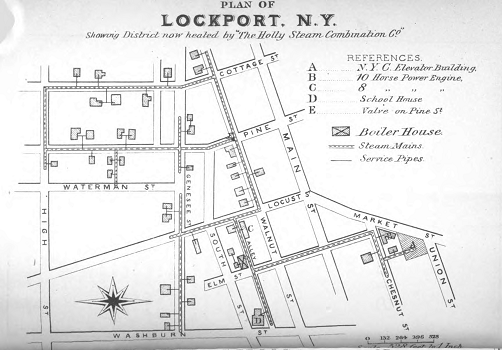
Map of District Heating System in Lockport |
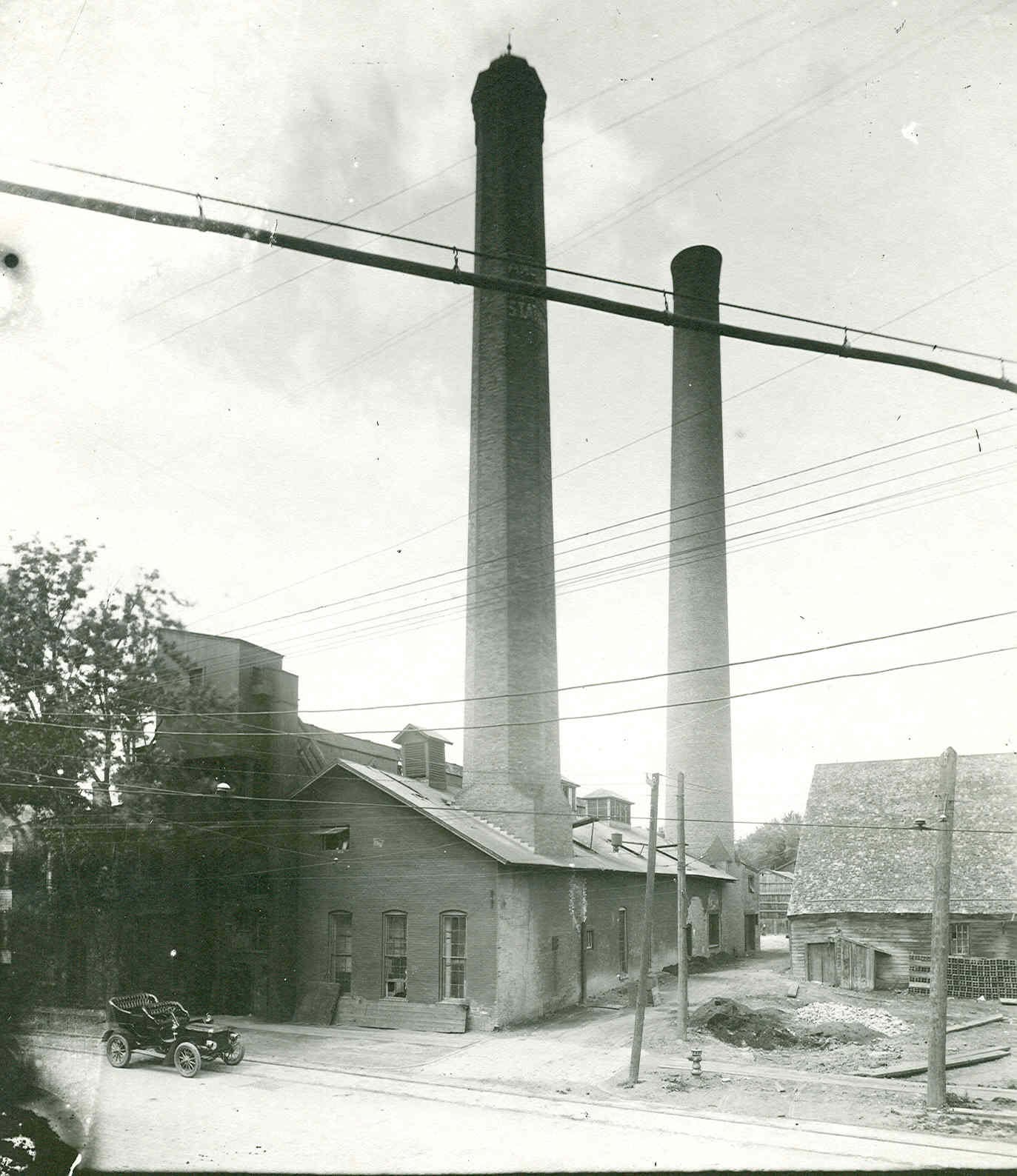
Holly Steam Plant in Lockport |
Birdsill Holly was born in Auburn, New York on November 8, 1820. He joined the Seneca Falls firm of Silsby & Race in 1853, which became Silsby, Race & Holly. When the Village of Lockport recognized the need to develop manufacturing in the village in 1858, several residents invited Holly to come to Lockport. The Holly Manufacturing Company was organized on May 2, 1859 with a capital of $20,000, with former New York Governor Washington Hunt, former Congressman Thomas T. Flagler, Charles Keep, Silas H. Marks, L.F. Bowen, G.W. Bowen, and Birdsill Holly as stockholders. Under superintendent Holly the company made sewing machines, a variety of pumps, and other metal goods. After a serious fire in Lockport in 1863 Holly conceived the idea of using one of his rotary pumps to force water through pipes to fire hydrants using what he called "direct pressure." The village approved his plan and it was demonstrated in August 1863. Holly recognized that a large potential market existed for urban fire protection systems and sold a system to his hometown of Auburn where a system began operating in November 1865. Holly then secured several patents covering his ideas and published a pamphlet in March 1867. Several other cities bought systems, although not all worked well. Holly also had to deal with several imitators and the company filed suits for patent infringement.
By June 1876 the company's stockholders expressed concern about the large amounts being paid to defend Holly 's patents in the numerous infringement cases and it was suggested that the firm close down. Holly carried on with the patent suits, but largely left the firm to pursue another idea of distributing steam to multiple buildings from a central boiler plant. He then formed the Holly Steam Combination Company with a different set of investors to develop and sell district steam systems.
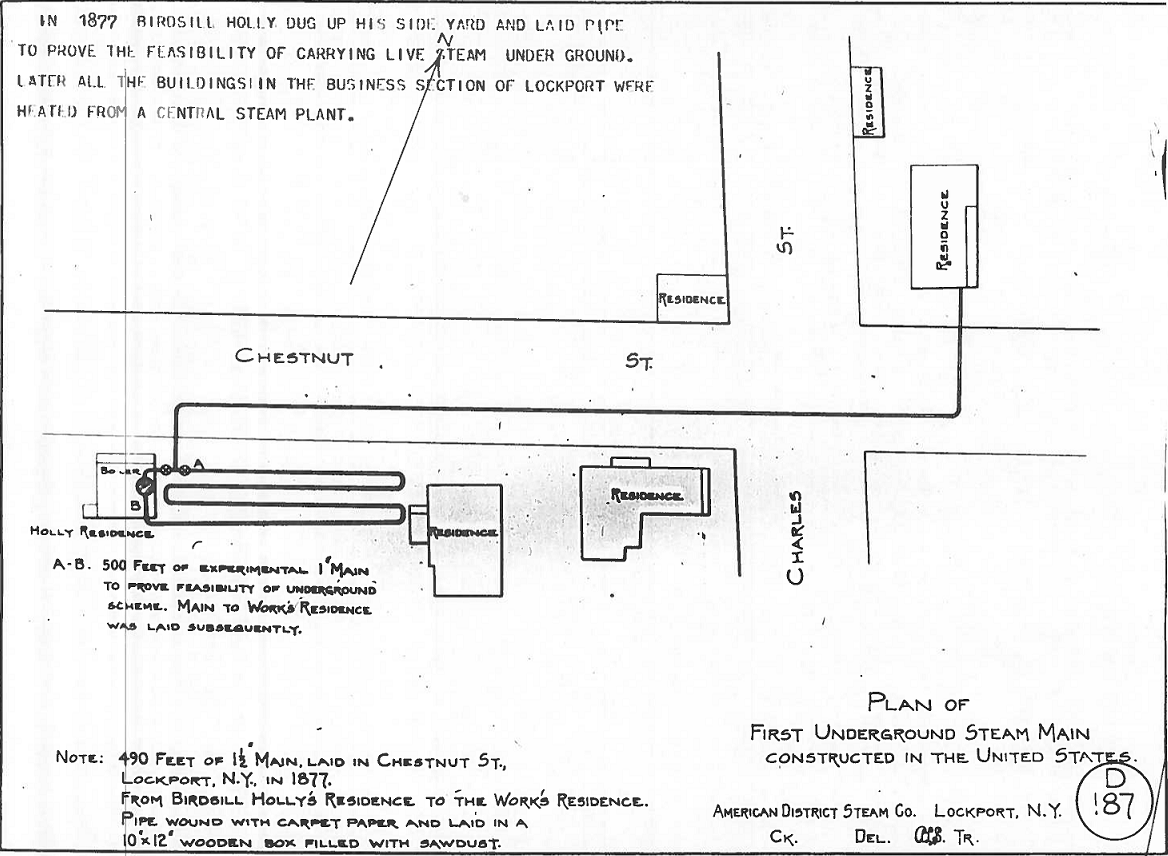
The following month, Holly began experimenting with underground steam pipes to determine how much heat was lost. He first installed 500 feet of one-inch pipes in his yard to measure the losses, and that proving satisfactory installed a 490-foot 1½-inch steam line laid in a 10"x12" wooden box filled with sawdust.to the house of Mary C. Works, widow of Samuel Works. A sketch of the original piping layout was included on page 5 of the second issue of the ADSCO Advocate in 1877 and also on page 156 of District Heating in April 1959.
Satisfied with the results, Holly solicited a group of local businessmen who were not affiliated with the Holly Manufacturing Company to form a new corporation in January 1877, which was called the Holly Steam Combination Company (Limited). The company at the end of February asked the common council for permission to install steam pipes in a limited area of the city, which was approved. Three weeks later they requested that the territory be expanded to the entire city, which was also passed. A boiler plant was built on Elm Street and installation of 2,350 feet of steam pipes from 2 to 4 inches in diameter began and the system was tested on July 12th, when steam was supplied to Samuel D. Hooper residence at 129 Walnut along with and others. Numerous additional residences were being served satisfactorily by September of that year and two additional miles of pipe were laid in October and November.
The following June the company published an Announcement that it had heated "about forty large dwellings, scattered along the line, also a large school building of 105,000 cubic feet and the largest hall in the city, besides furnishing steam to run two engines, one of them nearly half a mile distant from the boiler-house, and are supplying steam for a number of other purposes." A map of the initial steam pipes was also published and it is possible to identify almost all of the initial customers. A list of them was also included.
The American District Steam Company inherited the system in 1881 with the takeover of the Holly Steam Combination Company. They ran the system until 1905, when it was taken over by the Economy Light, Fuel, & Power Company, which was closely related to the American District Steam Company and also received a franchise to provide electric service. The Economy company rebuilt the Elm street plant and installed backpressure steam engines to provide exhaust steam to the system, which had been rebuilt to accommodate the lower steam pressure. The Lockport Gas and Electric Light Company also received a franchise in October 1905 to supply steam and began installing steam pipes and began service from its plant on Race street. The resulting electric and steam competition resulted in the two companies merging on January 1, 1908 as the Lockport Light, Heat and Power Company. Several of the steam engines were replaced with a 1,500 kW Terry steam turbine in 1927, which likely operated until the plant was shut down in 1969.
The system was transferred to the New York State Electric and Gas Corporation on October 31, 1929
The system served a maximum of about 400 customers. The company announced in 1964 that it intended to shut the system down after two more years. At the time there were 159 customers. Service was ended on June 15, 1969.
References
1876 The
Holly Steam Combination Company, Limited, Lockport
Preliminary Certificate Filed November 27, 1876
Final Certificate of Incorporation, January 17, 1877
Capital $25,000
Business: Manufacturing and putting into use machinery, pipes and
appliances for supplying steam for heating, and machine labor.
1876 "A
New Experiment--Mr. Holly Proposes to Heat Whole Cities by Steam," Rochester
Daily Union and Advertiser, December 1, 1876, Page 2.
Some of the Benefits of this New Invention Explained -- Likewise the
Drawbacks
1876 "Heating Cities by Steam," Rochester Daily Union and Advertiser, December 6, 1876, Page 2.
1877 "The Holly Steam Combination Company," Lockport Daily Journal, January 5, 1877, Page 4.
1877 "Holly Steam Combination Company Election," Lockport Daily Union, January 8, 1877, Page 3.
1877 "Heating a City by Steam," The World (New York, New York, January 24, 1877, Page 5.
1877 "Holly's
Heating System," Lockport Daily Union, January 29, 1877,
Page 3.
The New York World of Friday devotes a large space in its columns
to explaining Mr. B. Holly's system of warming a city by underground
transmission of heat.
1877 "The Tide for the Holly Steam Heating Company," Lockport Daily Union, January 30, 1877, Page 3.
1877 "More
About Heating Cities by Steam," Rochester Daily Union and
Advertiser, January 30, 1877, Page 2.
A book has also been published by Holly.
1877 "The Holly Steam Heating Project," Lockport Daily Union, January 31, 1877, Page 3.
1877 "Wholesale
Warming," Indiana State Sentinel, February 7, 1877, Page 12.
Mr. Holly's Plan for Heating Whole cities by Steam
1877 "Corporation
Proceedings," Lockport
Daily Journal, February 28, 1877, Page 4.
Petition of the Holly Steam Combination Company (limited), for permission
to open streets and alleys between Main street and High street (north and
south), and Washburn street and Transit street (east and west) for the
purpose of laying steam mains and pipes for heating and manufacturing
purposes, etc. Adopted.
1877 "Heating
Cities by Steam," The Colorado Banner, March 1, 1877, Page
Details of the Plan by Which Mr. Holly Will Heat the City of Lockport,
N.Y.
[From the New York World.]
1877 "Heating a City by Steam," The Metal Worker 7(9):95 (March 3, 1877)
1877 "Petitions,"
Lockport Daily Journal, March 21, 1877, Page 4
The Holly Steam Combination Company (Limited) respectfully ask that you
extend the territory to be occupied by their steam mains and laterals, so
as to embrace all streets and alleys in the city. Grants, under the
same conditions as the petition of Feb. 27th ult.
1877 "Steam
Heat for a Whole City," The Metal Worker 7(26):338 (June 30,
1877)
Steam Heat for a Whole City. The Lockport Union describes the
progress made in the introduction of the new system as follows: The
construction of Holly's apparatus for heating the city progresses
satisfactorily to the shareholders. The plan adopted is calculated to heat
all buildings within one-fourth of a mile in all directions from the
location of the boiler. The saving will be in coal and stoves, and the
great wear and tear from their use. Mr. Holly thinks the cost will be no
more than one-half to two-thirds that under the present system. His
figures, which have been published, are very plausible. The boilers, which
we will not attempt to describe, are placed in a new and substantial brick
building, erected for the purpose, on Elm street. The generating
apparatus looks quite formidable, and capable of producing heat sufficient
to keep all Lockport in a sweat. From this foundation of heat the supply
is forced through pipes laid under ground to the buildings which are to be
warmed. The main pipe, constructed of iron, is in size about five inches
in diameter. Around the pipe is wound hair cloth one half to
three-quarters of an inch in thickness, and over this is wrapped heavy
Manila paper. Thus prepared, the pipes are laid in hollow logs, which are
covered with zinc. It seems impossible for any considerable amount of heat
to escape, and when the pipes are once heated the waste cannot be very
great. At proper intervals are located stations or receiving boxes, the
pipes extending and leaving the station at opposite sides, so that a foot
or so of intervening space permits the expansion and contraction of the
pipes without injury to the general works. From the stations the heat is
transmitted to buildings, and attached are receptacles for drippings.
1877 Lockport Daily
Union, July 6, 1877, Page 3.
Not many days will elapse before the Heating by Steam experiment will be
thoroughly tested. Great confidence is felt by our citizens
generally that it will prove a success.
1877 Lockport
Daily Journal, July 10, 1877. Page 4.
Neighboring cities watch with interest the progress of Mr. Holly's project
for heating all Lockport by steam. The pipes are nearly all down,
and the system will be given a trial in a few days.--Utica Observer
1877 Rochester
Daily Union and Advertiser, July 13, 1877, Page 2.
Much interest is felt in the progress of Mr. Holly's project for beating
all Lockport by steam. The pipes are nearly all down, and the system
will be given a trial in few days. [Exchange
There can be little doubt but that the effort to heat Lockport up at this
time will prove successful.
1877 "Trouble
in the Steam Heating Company," Lockport Daily Journal, July
16, 1877. Page 4.
We are sorry to learn that there has a serious trouble arisen among the
stockholders of the Lockport Steam Heating Combination Company, which, if
not adjusted at once, will lead to litigation that, to say the least, will
be decidedly unpleasant for all concerned. Endeavors are being made
to amicably settle the affair, consequently we deem it considerate to
refrain from giving the fact publicly at this time.
1877 "Steam
Expansion which Causes an Explosion," The Buffalo Sunday Morning
News, July 22, 1877, Page 3.
Lockport, July 21, 1877. The work was pushed forward as rapidly as
circumstances would the permit and as the time approached for first trial
to take place, the Steam Heating Company were on the very tip-toe of
expectation. Finally, everything being in readiness, July 12th was the day
set aside for the great test, which was made from radiators that had been
placed in the residence of S. H. Hooper, and at other places, which was
highly satisfactory to all concerned.
1877 Lockport Daily
Union, July 23, 1877, Page 3.
The steam heating company has commenced excavating for laying of pipe
through the valley from Elm street to Washburn.
1877 Rome
Sentinel, July 24, 1877, Page 2.
Much interest is felt in the progress of Mr. Holly's project for beating
all Lockport by steam. The pipes are nearly all down, and the system
will be given a trial in few days.
1877 "The
Holly Heating Company and Washburn Street Schoolhouse," Lockport
Daily Journal, July 28, 1877, Page 4.
Proposal to install steam heating apparatus for twelve hundred dollars and
to warm the building during the school hours for the ensuing year for
three hundred dollars.
1877 Lockport
Daily Journal, August 30, 1877, Page 4.
Among the patents recently issues are several to Mr. Holly, of waterwork
fame, for his system of warming a city steam, supplied, as gas and water
are now, through a series of mains.--New York Sun
1877 "The
Holly Steam Heating Co. and Washburn Street School House," Lockport
Daily Journal, September 3, 1877, Page 4.
Contract for steam service, apparatus to be installed by November 1st.
1877 Lockport
Daily Journal, September 22, 1877, Page 4.
The steam-heating business is now working satisfactorily in a number of
private residences.
1877 Lockport
Daily Journal, October 24, 1877, Page 4.
The Steam Heating Company are industriously engaged putting their heating
apparatus in the residences of citizens.
1877 "Lockportians,"
The Buffalo Sunday Morning News, December 2, 1877, Page 3.
The Steam Combination Company is pushing its worth rapidly forward so as
to have its operations unimpeded before Winter sets in for good.
1877 Lockport
Daily Union, December 14, 1877, Page 3.
The steam heating company has put steam into the Daniels building, corner
of Market and Union streets, and will probably make a test in that
locality this afternoon.
1878 "Steam
Heating," Buffalo Express, January 31, 1878, Page 4.
Description of steam pipe installed by Buffalo brewery owner Jacob Scheu
to his residence at 1146 Niagara Street in Buffalo.
1878 "Steam
Heating," Buffalo Courier Express, February 2, 1878, Page 4.
The new Lockport system in practical operation
The account was read with much interest, which was not lessened by the
fact that heretofore the operations of the Holly Heating Company have been
conducted with such secrecy as to have entirely prevented any public
statement of their progress and results.
Twenty dwellings scattered on the line were connected with the junction
service pipes, and the tests proved the entire feasibility of the system
During the months of October and November, 1877, two miles of additional
mains were laid.
They are successfully warming at an average of seventy degrees, a large
school building containing 105,000 cubic feet of space, the largest hall
in the city, and rooms in the same building, making about 150,000 cubic
feet of space; and forty large dwellings; and are running two steam
engines, one of them being over half a mile from the boiler-house.
1878 "Steam
Heating," The Western New Yorker, March 7, 1878, Page 1.
Mentions articles from several newspapers.
1878 "Cheap
Heat," Western Insurance Review 11(8):371 (May 1878)
Complete reprint of the February 2, 1878 article from the Buffalo
Courier-Express.
1878 "Heating a City by Steam," The Metal Worker 9(18):1 (May 4, 1878)
1878 Report on Lockport
System, by Birdsill Holly, May 18, 1878 [No copy of this has been found]
No copy of this has been found, but portions were reprinted in Appletons'
Annual Cyclopaedia and Register of Important Events of the year 1878
and District
Steam Supply by James Herbert Bartlett 1884:12-15 | also here
| pdf |
Page 12: During the past winter, an equivalent of 65 houses on
nearly three miles of underground pipe, have been heated, and an accurate
record has been kept from day to day on the amount of coal consumed.
1878 Announcement of the Holly Steam Combination Company Limited, of Lockport, N.Y. : for supplying heat to private dwellings and public buildings of every description, from a central point, through street mains and laterals, and to measure the steam used to each consumer. | also here | and here | June, 1878
1878 Kirwin's Directory of the City of Lockport and County of Niagara for the year 1878, June 26, 1878
1878 History
of Niagara county, N. Y., with illustrations descriptive of its
scenery, private residences, public buildings, fine blocks, and
important manufactories, and portraits of old pioneers and prominent
residents
Page 185: Holly Steam Heating Works
1878 "Store
Rented," Lockport Daily Journal, October 9, 1878, Page 4.
Mr. Isaac H. Babcock has rented his store on Main street, next to L.H.
Hill's grocery store, to the Holly Steam Heating Company, for the purpose
of showing to persons the steam heating apparatuses which are used in
heating houses, stores, etc.
1878 "The
Holly Steam Heating System," Lockport Daily Journal,
November 1, 1878, Page 4.
The Journal Building is now heated by the Holly Steam Heating Company,
commencing yesterday, Oct. 31st.
1878 "Heated
by Steam," The Indiana State Sentinel, November 20, 1878,
Page 3. | also here
|
The City of Lockport Warmed by the Holly System. An Idea Which
Promises to be Generally Adopted.
[Correspondence New York World]
1879 "Holly
System of Steam-Heating," Appletons' Annual Cyclopaedia and
Register of Important Events of the year 1878 13:421-423 (1879) | pdf |
Page 421: The Holly system was first introduced into the town of
Lockport, where the works commenced running in October, 1877. During the
following winter 40 houses were warmed, besides a large schoolhouse and a
public hall, and the power was furnished to drive two steam-engines, one
of which was nearly half a mile away from the boiler-house.
1879 "Heating
Houses by Steam," The Building News and Engineering Journal
36:49 (January 10, 1879)
The first experiment was made at Lockport, near Niagara Falls--a town
situated a little north of the 43rd parallel of N. latitude. In June,
1877, the experiments were commenced by laying half a mile of pipes
underground to obtain a datum for calculating the carrying capacity of
tubes, and the rate of loss by condensation. The results were encouraging,
and before the winter set in about three miles of piping, mostly 4 in.,
had been laid down, the greatest continuous length being one mile and a
third. Although Lockport is some 8° nearer the equator than London it is
considered to be a cold region, and the test made by the company in
the winter of 1877 was, therefore, regarded as practically demonstrating
feasibility of the scheme. Since the commencement of their operations the
company has efficiently warmed about forty houses, a large school-room,
the town hall, and, besides supplying steam for other purposes, have run
two steam-engines, one of them situated about half-a-mile from the
boilers. Some of the houses were more than a mile from the source of heat,
but were warmed as satisfactorily as those near the boilers.
1879 The
Diary of James A. Garfield Volume 4 - 1878-1881
Page 318-319: November 31, 1879. Took the eight o'clock train
to Lockport. After dinner Richard Crowley drove me to visit the
Holly Water Works and also Holly's City Heating Works. The latter will
come into general use I think. The former is likely to be superseded
by Greene's system of gangs of driven wells.
1880 Lockport
Daily Journal, January 26, 1880, Page 4.
The artesian well at the Holly Steam Heating Shop, on Elm Street, has been
sunk to a depth of one hundred feet without water having been
obtained. The machinery is driven by steam furnished by the company.
1880 Third
annual announcement, Holly Steam Combination Company | another
copy | [April 1880]
Page 16: Forty buildings were supplied with heat, comprising
dwellings, stores, shops, hall and school-house, scattered along the line
of pipes, and power was furnished to one elevator and one twenty
horse-power engine.
Page 18: During the winter of 1878-9, the pipes were extended to
over four miles and over two hundred buildings were warmed—the number
being limited by the ability of the company to supply fittings.
1880 Hartford
Courant, October 7, 1880, Page 2.
The Holly Steam Combination company of Lockport, N. Y., have increased
their capital to ten millions of dollars, which increased capital has all
been taken by strong parties. The principal office of the company is to be
removed to New York city. The company will begin at once the construction
of steam heating companies in all of the leading cities
1881 "Steam
Heating Matter," Lockport Daily Journal, January 21, 1881,
Page 4.
Articles of incorporation of the American District Steam Company.
1881 Buffalo
Weekly Express, January 27, 1881, Page 2.
The "American District Steam Company" is the name of a new company just
formed at Lockport with the following officers : President. Dr. D. F.
Bishop; Vice-President, W. C. Andrews; Secretary, B. D. Hall ; Treasurer,
J. H. Babcock. The capital stock is to be $10,000,000, consisting of
100,000 shares at $100 a share.
1882 Lockport
City Directory 1882-1883
Page 35: Incorporated Companies - American District Steam Co.--31
Main street. Organized January, 1881, successors to Holly Steam
Combination Co. Capital $10,000,000. Dr. D. F. Bishop, pres.; W. C.
Andrews, Cleveland, O, vice pres.; B. D. Hall, sec.; I. H. Babcock, treas.
Page 115: American District Steam Company advertisement
1885 New
York Tribune, April 26, 1885, Page 7.
Dr. David F. Bishop, the president of the American District Steam Heating
Company and leading stockholder, dropped dead at 5 p.m. yesterday of heart
disease, age fifty -eight.
1895 "Wallace
C. Andrews," America's Successful Men of Affairs 2:19-21
President of The New York Steam Co., a man of marked vigor and enterprise,
is one of a large number of successful Ohio men, now engaged in business
in New York city. Mr. Andrews is of New England descent. He is a son of
the late Norman Andrews, who moved from Connecticut to a farm on the
Western Reserve in Ohio in 1816.
Mr. Andrews began life upon the farm, and partly by inheritance, partly in
the wholesome life of the country, acquired the physical vigor which
enabled him to perform great labors during his subsequent career. He
revealed a talent for business early in life. He succeeded from the start,
and, by the strictest economy, managed to save a little capital. When coal
was discovered in the Mahoning Valley, his brother, the late Chauncey H.
Andrews of Youngstown, O., and he, invested their savings in explorations
for coal and the purchase of mines. They developed a large number of
different properties. At first, they met with poor success, but finally
made valuable discoveries. The two men looked after details themselves,
conducted their business economically, and were able to mine coal, even
after the profits had fallen to 25 cents a ton. During the petroleum
excitement, they became operators in that industry also. They were also
promoters of many new enterprises. They built furnaces and rolling mills
in Ohio, and now and then a small railroad, and finally became the
principal stockholders in a railroad between Cleveland and Pittsburgh.
They bought several coal mining companies, working the mines themselves,
but afterwards selling them at an advance. In this way, in time, they
became the largest miners of coal in the State.
At a later day, they bought the bed of one of the old-time Ohio canals and
used it for a railroad between Cleveland and Pittsburgh, a rival to the
one they had already built. Their operations were usually
profitable, and the two brothers each gradually amassed a fortune. With
other capitalists, they finally secured a large area of coal lands in the
Hocking Valley in Ohio, and were interested in the purchase of The Hocking
Valley Railroad and its connecting lines and in the transaction by which
the roads were consolidated and the lands purchased. The schemes of Mr.
Andrews were usually started with comparatively little capital, but the
projector threw his whole energy into development, secured the investment
of outside capital, made his projects profitable, and then often sold his
interests. By reinvesting rapidly, working somewhat with borrowed money,
making use of his more valuable securities as collateral, he has succeeded
remarkably in the acquisition of wealth.
Mr. Andrews is one of the promoters of the original Standard Oil Co. and
was a director of the company for a long period of years and up to the
formation of the Trust. He is yet a large stockholder in the
company. One of the most important of his enterprises is The New York
Steam Co., a concern which supplies steam for heat and power by
underground pipes in various sections of New York city, and has initiated
a new era in the management of office buildings, by enabling their
proprietors to dispense with the annoyances attending the production of
steam in their own premises. Mr. Andrews is president of the company, and
has managed its affairs with signal ability and success. He was lately
president of The Standard Gas Light Co. of New York and is its largest
stockholder. He is a director in many local corporations, a man of unusual
business sagacity, of great power of application, and untiring energy, and
his large fortune is entirely the product of constructive talent and
commendable business methods. The Ohio Society of this city has enrolled
him as one of its members from the beginning.
1903 Sanborn Fire
Insurance Map from Lockport, Niagara County, New York, July 1903
Plate
4: Lockport Gas & Electric Co. plant on Race Street
Plate
13: American District Steam Co. plant on Elm Street
1905 American
Gas Light Journal 83(14):528 (October 2, 1905)
THE Lockport (N. Y.) Gas and Electric Light Company has contracted with
the Niagara, Lockport and Ontario Power Company for the supply of power
commencing November 1, 1905. The light company will pay the power company
$20 per horse power per annum for 20 years.
1905 "Franchise
granted to Economy Light, Fuel & Power Company," October 16,
1905, Revised Charter and Ordinances of the City of Lockport
No rights conferred to the Economy Light, Fuel & Power Company
shall be operative unless said company acquire the underground heating
system now in operation in the city and continue to operate the heating
plant under the grants of this franchise for its term.
1905 "Franchise
of Lockport Gas & Electric Light Company," October 23, 1905, Revised
Charter and Ordinances of the City of Lockport
For furnishing steam on the north side of the Erie canal within said
city of Lockport.
1906 "Cheaper
Power is Promised Without Release of Contracts," Lockport Daily
Journal, April 4, 1906, Page 4.
The Economy Light, Fuel & Power company will take over the plant about
May 15 or 20.
1906 "Economy
Company Means Business," Lockport Daily Journal, June 26,
1906, Page 4.
Old plant being torn down and replaced with larger new building.
Electrical power will be in operation by Oct 1, while the steam heating
plant would be ready by Sept. 20.
1906 "Steam: Mains of Gas Company Being Installed. First Actual Step Toward Competition in City Heating Taken Today," The Niagara Sun, July 20, 1906, Page 8.
1906 "Slash
of Prices for Steam Heating," The Niagara Sun, October 5,
1906, Page 8.
Economy Co. says rival's policy if evidently one of rule or ruin.
It constructed a steam main through the business streets and is now
delivering the product from its Race Street plant.
1907 "Lockport
Light, Heat & Power Company," Reports of Decisions, New York
Public Service Commission, August 8, 1907
Lockport Gas and Electric Light Company authorized to transfer its
Franchises and Property to the Lockport Light, Heat & Power Company
Economy Light, Fuel & Power Company authorized to transfer its
Franchises and Property to the Lockport Light, Heat & Power Company
Also history of the two corporations.
1907 Public
Service Commission, Second District, December 21, 1907
Lockport Light, Heat and Power Company authorized to acquire Economy
Light, Fuel and Power Company and Lockport Gas & Electric Light
Company.
1908 Lockport Light, Heat and Power Co. took over the properties of the Lockport Gas & Electric Light Co. and the Economy Light, Fuel & Power Co. on January 1, 1908 Moodys 10:2036 (1909)
1909 "System
of the Lockport Light, Heat & Power Company," Electrical
World 53:1077-1079 (May 6, 1909)
The Economy Light, Fuel & Power Company was organized in 1905 to take
over the local steam-heating business of the American District Steam
Company. In this business there had been invested a large amount of money
for a central steam-generating plant and an expensive distribution
system. In 1905 the idea was conceived that the steam produced at a
properly constructed central station could be utilized in producing
electrical energy for lighting and power purposes and that the exhaust
steam from the engines could be utilized for heating. Accordingly the
company obtained a local franchise and prepared to enter the field of
electric lighting. A lively warfare ensued between the two companies and
the Lockport Gas & Electric Light Company began to engage in the
business of supplying steam heat. It is significant, however,
that a steam-driven station using exhaust steam for heating purposes was
able to compete with a company selling Niagara energy.
Elm Street Generating Station
The plant which was erected by the Economy Light, Fuel & Power Company
on Elm Street consists of approximately 1800 hp of Heine and Stirling
water-tube boilers which are operated under a steam pressure of 155 lb. At
present there are installed one 600-kw, 2300-volt, 25-cycle, two-phase
General Electric alternator, direct-connected to a 810-hp Ball engine; one
260-kw, 2250-volt, 60-cycle, three-phase Westinghouse alternator and one
190-kw alternator of similar output and make. The latter generators are
direct-connected to Fleming four-valve, high-speed engines designed to
operate during the heating season under a back pressure of from 6 lb. to
10 lb. Besides the direct-connected exciter sets there is a 30-hp
motor-generator set provided, and to supply a limited amount of direct
current a synchronous motor-generator set, rated at 85 kw, is installed. A
10-hp induction motor is connected to the shaft of the set and is used in
starting it.
The company has between six and seven miles of underground steam mains
supplying steam for heating to approximately 12,000,000 cu. ft. of space
in residences, churches, schools, public buildings and business houses,
the number of customers being about 500. The first underground steam
construction was installed in 1876 and has since that time been extended
every year. During the past seven or eight years the old construction was
taken up and the present standardized type of construction, known as the
improved Holly system, was put down under the direction of the contractor,
the American District Steam Company. At the time of this reconstruction
the mains were also increased in size with a view of their being operated
in connection with the electric light and power plant. The exhaust steam
due to the operation of the engines is fully utilized during the period
from the last of September until about the first of June, for heating. The
steam is sold strictly by meter. what is known as the Simplex condensation
meter being used. The buildings are fitted in the ordinary way, either for
one or two pipe steam or for the atmospheric system, or the steam is used
to heat water through the use of the American District Steam Company's
design of hot-water heaters, where hot-water heating is desired in any
building. Steam is also used in heating of water for plunge or
shower baths and for general domestic use in the same manner. The
pressure carried in the underground mains ranges from 1 lb. to 7 lb.,
depending upon the outside temperature, wind velocity and humidity.
1909 Sanborn
Fire Protection Map from Lockport, Niagara County, New York,
August 1909
Plate 9: Race power plant of the Lockport Light, Heat & Power
Co., formerly Lockport Gas & Electric Company
1914 "Reminiscence
and the Early Day Struggle of Central Station Steam Heating," by
John Walsh
Walsh was the superintendent of the Lockport heating plant from when it
opened until close to his death in 1915.
1915 John D. Walsh (1845- Apr 13, 1915) grave
1914 State
of New York, Public Service Commission, Second District,
Volume III, December 31, 1913
Page 327: Lockport Light, Heat and Power Company
1915 State
of New York, Public Service Commission, Second District,
Volume III, December 31, 1914
Pages 304-305: Lockport Light, Heat and Power Company
1916 State
of New York, Public Service Commission, Second District,
Volume III, December 31, 1915
Page 319: Lockport Light, Heat and Power Company
Number of customers 380
1917 "City
Faces Coal Famine if Cars are not moved," The Buffalo News,
February 14, 1917, Page 1.
Eighteen carloads of coal were taken from the Gardenville freight yard to
Lockport yesterday, which enabled the Lockport Light & Power company
to continue operation of its plant. The plant yesterday noon was about to
close down for lack of coal. which would have meant intense suffering in
hundreds of Lockport homes heated by the company's supply, as well as
shutting down of industries.
1918 State
of New York, Public Service Commission, Second District,
Volume III, December 31, 1917
Page 257: Lockport Light, Heat and Power Company
Number of customers 403
1919 State
of New York, Public Service Commission, Second District,
Volume III, December 31, 1918
Page 263: Lockport Light, Heat and Power Company
Number of customers 400
1920 State
of New York, Public Service Commission, Second District,
Volume III, December 31, 1919
Page 269: Lockport Light, Heat and Power Company
Number of customers 400
1921 State
of New York, Public Service Commission, Second District,
Volume III, December 31, 1920
Page 227: Lockport Light, Heat and Power Company
Number of customers 364
1922 State
of New York, Annual Report of the Public Service Commission,
Volume II, December 31, 1921
Page 872-873: Lockport Light, Heat and Power Company
Number of customers 357
1923 State
of New York, Annual Report of the Public Service Commission,
Volume II, December 31, 1922
Page 834: Lockport Light, Heat and Power Company
Number of customers 365
1924 State
of New York, Annual Report of the Public Service Commission,
Volume II, December 31, 1923
Page 898-899: Lockport Light, Heat and Power Company
Number of customers 400
1925 State
of New York, Annual Report of the Public Service Commission,
Volume II, December 31, 1924
Page 898-899: Lockport Light, Heat and Power Company
Number of customers 400
1926 State
of New York, Annual Report of the Public Service Commission,
Volume II, December 31, 1925
Page 861-862: Lockport Light, Heat and Power Company
Number of customers 380
1926 "Aero
Pulverizer Accomplishments," Heat Engineering 1(11):10-16
(November 1926)
Coal pulverizers as the Lockport Light Heat and Power Company
1927 State
of New York, Annual Report of the Public Service Commission,
Volume II, December 31, 1926
Page 831-832: Lockport Light, Heat and Power Company
Number of customers 376
1927 Electric generators at Elm Street plant replaced with a 1,500 kW turbo-generator.
1928 State
of New York, Annual Report of the Public Service Commission,
Volume II, December 31, 1927
Page 801-802: Lockport Light, Heat and Power Company
Number of customers 376
1929 State
of New York, Annual Report of the Public Service Commission,
Volume II, December 31, 1928
Page 839: Lockport Light, Heat and Power Company
Number of customers 401
1928 McGraw
central station directory : a complete list of electric light and
power companies with data (1928)
Page 457: Lockport Light, Heat & Power Co.
Capacity Elm St. Plant
A.C. Generator 2,400 kva
Steam turbine 2,080 hp
Steam engine 500 hp
1930 State
of New York, Annual Report of the Public Service Commission,
Volume II, December 31, 1929
Page 823-824: Lockport Light, Heat and Power Company
Number of customers 401
1930 Public
Service Commission, Annual Report, December 5, 1929
Page 16: An order made by the Public Service Commission on December
5, 1929, permitted the Lockport Light, Heat and Power Company to transfer
its franchises, works and system used in connection with the sale of
electricity, gas and steam to the New York State Electric and Gas
Corporation, as of October 31, 1929.
1931 State
of New York, Annual Report of the Public Service Commission,
Volume II, December 31, 1930
Page 823-824: New York State Electric & Gas Corporation
Number of customers 406
1932 State
of New York, Annual Report of the Public Service Commission,
Volume II, December 31, 1931
Page 901-902: New York State Electric & Gas Corporation
Number of customers 390
1933 State
of New York, Annual Report of the Public Service Commission,
Volume II, December 31, 1932
Page 893-894: New York State Electric & Gas Corporation
Number of customers 360
1934 State
of New York, Annual Report of the Public Service Commission,
Volume II, December 31, 1933
Page 851-852: New York State Electric & Gas Corporation
Number of customers 325
1935 State
of New York, Annual Report of the Public Service Commission,
Volume II, December 31, 1934
Page 862: New York State Electric & Gas Corporation
Number of customers 343
1935 Supreme
Court Appellate Division Third Dept. Vol. 2577
Lockport Heat, Light and Power Company and New York Electric and Gas
Corporation
Page 806: There is one 1500 kilowatt Tary [Terry?] turbine and
one 500 kilowatt ball engine set, both generating electricity at 2300
volts, three phase.
In 1927 there was a 1500 kilowatt turbine and a new boiler feed pump
installed.
Appeal
Page 45: During the Summer, the Elm Street steam station does not
ordinarily generate much or any electric energy (Fol. 1853). The Elm
Street plant is a steam generating station and is used both for the
generation of electricity for local distribution in Lockport and steam for
commercial heating. The principal items of equipment in the Elm Street
station are:
2 315 H.P. Heine Boilers (purchased in 1905)
1 400 H.P. Sterling Boiler (purchased in 1920)
2 750 H.P. Sterling Boilers (purchased in 1926 and 1928)
1 1500 K.W. Steam Turbine and Allis Chalmers generator (purchased in 1927)
1 810 H.P. Ball Engine (purchased in 1908)
1 540 K.W. A. C. Generator (purchased in 1908)
The boiler pressure is 150 lbs. at which pressure some steam is fed to the
Harrison Radiator Company located across the street from the station
The turbine exhaust pressure is 12 to 20 lbs. and this is the pressure at
which steam is delivered to the low pressure mains of the City of Lockport
for delivery to various structures and buildings for heating purposes.
Were it not for the fact that the exhaust steam is used for heating
purposes, the exhaust pressure of the turbine would be at or less than
atmospheric pressure. The turbine acts as a reducing valve.
As shown by Exhibit 3, pages 4 and 5, “the Elm Street steam generating
station is primarily used to supply steam for the district heating system,
the generation of electricity being incidental, it should really be
classed as a part of the steam heating plant".
1936 State
of New York, Annual Report of the Public Service Commission,
Volume II, December 31, 1935
Page 901-902: New York State Electric & Gas Corporation
Number of customers 341
1937 State
of New York, Annual Report of the Public Service Commission,
Volume II, December 31, 1936
Page 868: New York State Electric & Gas Corporation
Number of customers 340 NYSEG bought the Elmira Light, Heat & Power
Company on November 30, 1936
1938 State
of New York, Annual Report of the Public Service Commission,
Volume II, December 31, 1937
Page 861-862: New York State Electric & Gas Corporation
Number of customers 543 including Hornell
1939 State
of New York, Annual Report of the Public Service Commission,
Volume II, December 31, 1938
Page 807-808: New York State Electric & Gas Corporation
Number of customers 499 including Hornell
1940 State
of New York, Annual Report of the Public Service Commission,
Volume II, December 31, 1939
Page 927-928: New York State Electric & Gas Corporation
Number of customers 483 including Hornell
1941 State
of New York, Annual Report of the Public Service Commission,
Volume II, December 31, 1940
Page 923-924: New York State Electric & Gas Corporation
Number of customers 448 including Hornell
1942 State
of New York, Annual Report of the Public Service Commission,
Volume II, December 31, 1941
Page 877-878: New York State Electric & Gas Corporation
Number of customers 451 including Hornell
1943 State
of New York, Annual Report of the Public Service Commission,
Volume II, December 31, 1942
Page 877-878: New York State Electric & Gas Corporation
Number of customers 446 including Hornell
1943 "Birdsill
Holly: Father of District Heating," Bulletin of the
National District Heating Association 29(1):12,28 (October 1943)
During the summer 2350 ft of 2 in. and 1 in. lines were run and 14
customers were connected. They began taking steam service in October
1877—just 66 years ago. Two years later over 14,000 ft of line was in
place and two boilers were operating at 30 pounds pressure.
1944 State
of New York, Annual Report of the Public Service Commission,
Volume II, December 31, 1943
Page 957-958: New York State Electric & Gas Corporation
Number of customers 472 including Hornell
1945 State
of New York, Annual Report of the Public Service Commission,
Volume II, December 31, 1944
Page 925-926: New York State Electric & Gas Corporation
Number of customers 476 including Hornell
1946 State
of New York, Annual Report of the Public Service Commission,
Volume II, December 31, 1945
Page 921-922: New York State Electric & Gas Corporation
Number of customers 482 including Hornell
1947 State
of New York, Annual Report of the Public Service Commission,
Volume II, December 31, 1946
Page 959-960: New York State Electric & Gas Corporation
Number of customers: Residential 275, Commercial 191, Power 1, Municipal 8
1948 State
of New York, Annual Report of the Public Service Commission,
Volume II, December 31, 1947
Page 663-664: New York State Electric & Gas Corporation
Number of customers 490 including Hornell
1949 Annual
Report of the Public Service Commission for the year ended December
31, 1948, Volume 2.
Pages 661-662: New York State Electric & Gas Corporation
Number of customers 349 -- Steam service in Hornell was discontinued at
the end of the 1947-48 heating season.
1950 Annual
Report of the Public Service Commission for the year ended December
31, 1949, Volume 2.
Pages 684: New York State Electric & Gas Corporation
Number of customers 356
1951 Annual
Report of the Public Service Commission for the year ended December
31, 1950, Volume 2.
Pages 686: New York State Electric and Gas
Number of customers 352
1953 "Birdsall
A. Holly III, Steam System Inventor," The Buffalo News,
November 11, 1953, Page 65
Holly III was Birdsill Holly, Jr.'s son, who opened the valve on the
Lockport steam system in 1877.
1955 "Where
District Heating Began," District Heating 40(3):100 (January
1955)
Cover picture of Birdsill Holly's house on Chestnut street, where a small
boiler was installed to test underground steam piping.
1959 "The
History of District Heating," by John F. Collins, Jr., District
Heating 44(4):154-161 (April 1959)
Page 158: Steam service began in October 1877, when 14 customers
were connected to the boiler operated at 30 psi.
1964 "Central Steam Heating Only 1 Holly Invention," Lockport Union-Sun & Journal, October 21, 1964, Page 22. | also here |
1964 "Have
you heard!," District Heating 50(2):67 (October 1964)
Lockport, New York
The Company has announced plans to close its steam plant and discontinue
its steam heating service in Lockport on June 15, 1966.
Mr. John C. Miller, Lockport District Manager, made the announcement in a
letter to 159 residential and commercial customers affected, and to
officials of the Harrison Radiator Division, which uses steam at its
downtown plant.
Mr. Miller said operation of the plant has been unprofitable for years,
despite all efforts to reduce costs through changes in operations and
facilities.
The Company has filed a petition with the Public Service Commission
requesting authority to discontinue the steam plant operation. The Company
will furnish steam for two more heating seasons to give customers adequate
time to investigate alternate heating sources and make the necessary
installation of equipment.
Company specialists have surveyed the heating requirements of the
customers involved. They will meet with each customer and if requested,
will assist in forming plans for economical conversion to other forms of
heating.
The Company has raised its steam rates several times, but the plant is
still operating at a loss. The present charge for steam heating is
considerably higher than for other types of heating and even another
substantial increase in rates would not make retention of the plant
feasible, Mr. Miller said.
He listed the following as among the factors which have made the steam
heating operation unprofitable: (1) A decreasing number of customers; (2)
Changed economic conditions; (3) Rising costs of supplying steam,
including maintenance; (4) Decreases in the costs of heating sources. [The
shutdown was delayed until June 15, 1969.]
1984 "City
May Land in Hot Water with Municipal Heating Plan," The Buffalo
News, October 15, 1984, Page D1.
THE STEAM was produced in a boiler plant at South and Elm streets that was
almost entirely encircled by General Motor Corp.'s Harrison Radiator
Division Main Plant. After the system was shut down, Harrison bought the
plant, razed it and built a parking lot. At its peak, the steam system had
about 700 customers and the plant had a staff of 16 coal shovelers who
kept the boiler-fires roaring with pulverized anthracite. From the
utility's viewpoint, one of the headaches connected with the steam system
was metering the amount of steam used by each customer.
Includes picture of coal stokers at Lockport's former steam generating
plant.
1995 "The
road to Lockport: Historical background of district heating and cooling,"
by Morris A. Pierce, ASHRAE transactions 101:885-892, Part
1; PB: 1517 | pdf |
The idea of district heating can be traced back to Roman hypocausts, some
of which warmed multiple buildings. They were reintroduced into Europe
during the Renaissance and slowly evolved into modern hot air, hot water,
and steam heating systems. Major heating milestones are summarized, along
with requirements to conserve fuel and abate smoke. Early district-heating
proposals in London (1623 and 1820s), Pennsylvania (1869), Warsaw and
Zuerich (1872) are discussed, as are steam systems actually installed at
the US Naval Academy (1853), the Philadelphia Centennial Exposition, and a
hot water cogeneration system at the Banstead Downs Asylum in England
(1876). Birdsill Holly--a Lockport, New York, inventor--installed the
first successful commercial district heating system there in 1877. By
1890, more than 50 were installed, many of which are still operating
today. District cooling began shortly after that, with successful
introduction of systems using brine and ammonia.
1996 The Life and Times of Birdsill Holly: A Thesis in History, by Madelynn P. Frederickson. Master's Thesis in History from State University College at Buffalo | also here |
© 2024 Morris A. Pierce